Cirra AI Article
Claude Managed Agents vs. AI Orchestration Frameworks
Inside this article
- 01Executive Summary
- 02Introduction and Background
- 03Claude Managed Agents
- 04Claude Cowork and Personal Agents
- 05Hermes Agent (Nous Research)
- 06Zo Computer
- 07Orchestration Frameworks: Perplexity Computer and Paperclip AI
- 08Comparative Analysis
- 09Case Studies and Examples
- 10Implications and Future Directions
- 11Conclusion
Executive Summary
The emergence of “agentic” AI marks a pivotal shift from single-turn chatbots to systems that autonomously plan and execute complex tasks. Leading AI labs and startups have introduced platforms enabling coordinated, multi-step workflows. For example, Anthropic’s Claude Managed Agents provide a cloud-based, fully-managed execution environment for agents (code execution, web browsing, file I/O) to perform long-running tasks asynchronously [1] [2]. In parallel, Anthropic’s Claude Cowork and other “personal agents” like Hermes Agent and Zo Computer bring agent capabilities directly to users’ desktops or personal clouds. Claude Cowork runs on a user’s machine to handle local files and applications (e.g. organizing documents, running analysis pipelines) with minimal user prompting [3] [4]. Hermes Agent is an open-source personal AI agent with persistent memory, automated skill acquisition, and multi-platform integration (Telegram, Slack, email, etc.) [5]. Zo Computer offers a personal cloud server for AI tasks, integrating storage, code execution, and models from multiple providers (Source: www.zo.computer) (Source: www.zo.computer).
At the same time, new orchestration frameworks have emerged for managing collections of agents. Perplexity’s “Computer” is a subscription-based cloud platform that breaks user goals into sub-tasks, spins up sub-agents using a suite of 19+ top models (Claude, Gemini, GPT-5.2, etc.), and runs workflows asynchronously in isolated compute environments with real browsers and file systems [6] [7]. The open-source Paperclip AI toolkit allows developers to define “zero-human companies” staffed by AI agents, with built-in goal setting, role-based teams, heartbeats, and budget controls. Paperclip saw explosive adoption (38,000+ GitHub stars in its first month) by orchestrating multiple AI “employees” to achieve complex business objectives [8] [9].
In this report, we deeply examine each system’s design, capabilities, use cases, and underlying technology. We compare them along dimensions such as deployment model (cloud vs. local), autonomy and memory, tool integration, open-source vs. proprietary, and target users (individuals vs. enterprises). We draw on official documentation, technical analyses, and expert commentary to provide a thorough, evidence-backed comparison. Case studies and user examples illustrate each platform’s real-world use, while data – e.g. agent performance improvements on benchmark tasks [10] or reported time savings [7] – highlight differences. Finally, we discuss broader implications: workforce impact, governance and security (e.g. “trusted agent” frameworks [11] [12]), and future research directions.
Introduction and Background
Large language models (LLMs) such as GPT-4, Claude, and others have drastically improved generative AI capabilities. Initially used as chatbots or copilots, they are now embedded into autonomous AI agents that can “plan, act, and collaborate” with minimal human guidance. This agentic AI paradigm allows describing a goal in natural language and having the system break it into sub-tasks, interact with tools or external systems, and deliver a final result [6] [10]. Early experiments (e.g. AutoGPT in 2023) revealed that LLM agents could attempt multi-step tasks, leading to a surge of interest and new frameworks in 2024–2026 [10] [11]. Industry analysts predict that by 2026 half of all enterprise applications will incorporate task-specific AI agents, especially as memory and integration improve [11].
Despite vast hype, experts warn to distinguish genuine “agents” from basic assistants. As Dell CTO John Roese notes, many companies engage in “agent washing” by marketing simple retrieval tools as agents, whereas true agents are autonomous systems that perform work [13] [14]. Gartner’s research also underscores this: of thousands of AI vendors claiming agentic features, perhaps only ~130 deliver real autonomy [12]. Trust and security remain top concerns; Gartner predicts over 40% of agent-based projects could be canceled by 2027 due to cost overruns or unclear value [12]. This environment has driven development of secure, managed platforms as well as open-source alternatives to accelerate real-world adoption.
In the last two years, several distinct categories of agent solutions have emerged:
- Managed Agent Platforms (like Claude Managed Agents) provide a hosted, fully-managed infrastructure that runs agents in cloud containers with CRON, perpetual sessions, and built-in tools.
- Personal/Workstation Agents (Claude Cowork, Hermes, Zo) install on local machines or personal cloud servers to act on behalf of an individual, often with persistent memory.
- Orchestration Frameworks (Perplexity Computer, Paperclip) enable coordination of multiple agents/models, often focusing on high-level goal management and workflow execution.
This report examines each category in depth, comparing capabilities & limitations.
Claude Managed Agents
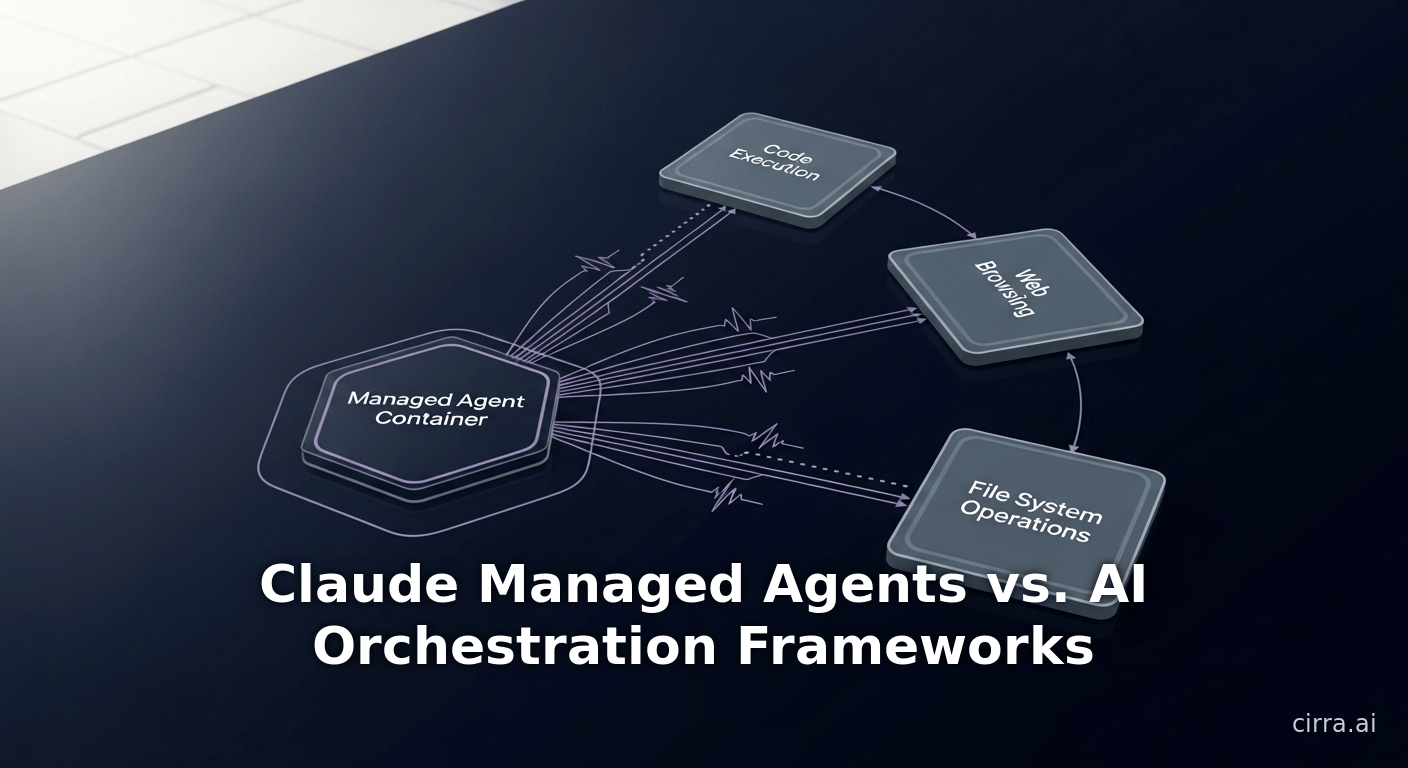
Anthropic’s Claude Managed Agents is a cloud-based agent orchestration service (currently in beta) that provides “the harness and infrastructure for running Claude as an autonomous agent” [15]. Unlike Anthropic’s standard Messages API (used for chatbots or custom loops), Managed Agents supplies a pre-built “agent harness” with secure execution environment. Key features from the official Claude docs include:
- Managed Containers: Each agent runs in a configurable container template with pre-installed runtimes (Python, Node.js, Go, etc.), network controls, and a persistent filesystem [16] [2].
- Built-In Tools: Claude is given access to a suite of tools: a Bash shell, file operations (read/write, grep, editing files), web search and fetch, and connections to external tool providers via “ MCP servers” ( Model Context Protocol [2].( MCP is a Dell/Anthropic standard for connecting LLMs with tools [17].)
- Sessions with Memory: Sessions persist conversation history and file changes across interactions, enabling stateful agents. The documentation notes “persistent file systems and conversation history across multiple interactions” [18].
- Autonomous Events: Once a session starts, the user sends “events” (user messages) and Claude autonomously executes tools, streaming back results via server-sent events. Developers need only define the agent’s system prompt, tool list, and environment, then send a single goal or message. The agent will loop, calling tools as needed, until the task is complete [19] [20].
- Scalability and Optimization: The platform handles prompt caching and compaction to improve performance over long sessions [15]. Multiple sessions can run in parallel, and the user’s app can fetch event histories from the Claude servers for review or debugging.
Crucially, Managed Agents target long-running, asynchronous workflows [21]. Anthropic’s docs state this is best for “long-running tasks and asynchronous work,” distinguishing it from the Messages API which is for “fine-grained control” of shorter loops [21]. Example use cases might include batch data processing, extended research jobs, or monitoring tasks. Because the infrastructure is managed by Anthropic, developers can focus on high-level specifications without setting up cloud servers.
A technical analysis by Third-Party (ClaudeLab, April 2026) emphasizes the advantages: managed agents allow Claude to “run code, observe the output, and iterate”, with sandboxing to ensure safe execution [21] [2]. Likewise, an AI Market Cap article highlights the interactive transcript/debug panels and the ability to live-test agents, positioning Claude Managed Agents as a potential “n8n killer” (compared to Node-RED or similar workflow tools) [22].
One industry commentator notes that Claude’s approach (via the Computer Use beta) is essentially a cloud agent service: Anthropic even calls it a “harness” that virtualizes fundamental agent components (LLM, tool execution, environment) [23]. A critical advantage cited is security and oversight – since Anthropic controls the container, it can enforce guardrails and resource limits. Indeed, the beta requires a special header and is subject to refining, showing Anthropic’s caution [24].
Nevertheless, Managed Agents are still new. As of early 2026 they are in private beta, so concrete adoption examples are scarce. One can infer potential enterprise appeal from Anthropic’s messaging: the fully-managed model is positioned for organizations that need robust, long-lived agents without in-house DevOps. By contrast, solutions like Perplexity Computer and Paperclip require more user infrastructure (see below).
Technical Capabilities: Under the hood, Managed Agents rely on Anthropic’s high-context models (e.g. Claude 3 / Opus with 100k+ token windows) to plan over many steps, plus real execution. The platform effectively grants the LLM programmability: for instance, it can open and modify files or run scripts within its container. Anecdotal testing suggests even in beta Claude will use these abilities effectively. Wired’s review of Claude Cowork (desktop agent) confirms Claude can “take over the browser to search the web” and manipulate file systems [4]. Managed Agents takes this online: the agent can fetch web content, use the shell, and call APIs (via MCP).
Clearly, Claude Managed Agents aspire to the idea of a “digital coworker” on the cloud. In this regard, they parallel Perplexity Computer (discussed later), but differ in being an LLM-agnostic, fully-managed Claude-specific service. Anthropic’s closed ecosystem may offer integration ease (one API, built-in scaling) at the cost of flexibility. Notably, security features like sandboxing may appeal to enterprises concerned about rogue agent behavior.
Claude Cowork and Personal Agents
Anthropic also offers a user-installable AI agent: Claude Cowork (sometimes called Claude Co-Work) [25]. Unlike Server-side Managed Agents, Cowork runs on the user’s own computer (Windows or Mac) and interfaces with local data. As Anthropic states, “Claude Cowork handles tasks autonomously. Give it a goal and Claude works on your computer, local files, and applications to return a finished deliverable” [25]. In essence, any repetitive or multi-step knowledge task can be offloaded to Cowork without requiring human orchestration.
Cowork grew out of Anthropic’s earlier tool Claude Code, which targeted developers. Cowork is essentially Claude Code made user-friendly for non-technical knowledge workers [26]. The key selling points of Claude Cowork include:
- Desktop Integration: Cowork operates on the user’s machine across file folders and apps. It “moves between” applications, scans email or spreadsheets, and can even interact with a web browser on behalf of the user [3]. In practice, a user might say: “Clean up my downloads folder and summarize the expense report,” and Cowork organizes files accordingly.
- No Prompt Loop Required: The user provides a single natural-language goal; Cowork then decomposes it into steps. Anthropic emphasizes that users need not break tasks into prompts themselves [27]. This is a big difference from traditional chatbots – Cowork is like a long-running agent on the desktop.
- Target Audience – Non-Technical: Anthropic explicitly targets non-technical knowledge workers (marketing, HR, analysts) with Cowork. The interface is graphical rather than a command-line interface. It can rename, sort, format files or extract data from multiple sources [28] [4].
- Autonomous File and App Operations: Reviewing Cowork’s demo workflows, tasks include “organizing and managing local files” (renaming, sorting a folder of draft documents), updating spreadsheets with collected data, generating reports from documents, etc. [28]. Wired’s hands-on test found Cowork could “organize files into folders, convert file types, generate reports, and even take over the browser to search the web or tidy up a Gmail inbox” [4]. Even in beta, reviewers were impressed that Claude actually executed these chores reliably when other agents had failed.
- Benefits: By automating tedious “high-effort repeatable” tasks, Cowork helps users not skip chores such as data scanning or feedback aggregation [29]. This yields more consistent work (e.g. never forgetting to update a spreadsheet) and ultimately “better decisions” as per Anthropic [29].
- Integration: Cowork runs on the desktop but may upload data to Anthropic’s web service for processing (Anthropic’s docs hint that tasks may use the cloud backend). The UI presumably lets the user chat with Claude and review what actions it took. (Unlike Managed Agents, this is presumably endpoint-to-endpoint – install app, log in to Claude.)
According to Wired, Cowork “feels like the start of a pleasant user experience” for agent-driven automation [4]. Unlike many prototype agents, it “actually works” for common tasks. This indicates a relatively mature implementation. Cowork leverages the same LLM technology (Claude) but in the user’s context. It does not require the user to code or configure tools like Managed Agents; instead, it relies on Anthropic’s UI to define goals.
While not an open framework, Claude Cowork represents the personal agent domain: private agents that help individuals with everyday work. Similar offerings are in development by other vendors (e.g. Microsoft Copilot, MacGPT), but Claude Cowork’s desktop-first approach is distinctive. It still requires trust in Anthropic (and the cloud) and presumably runs code on local files, raising questions about privacy and security. Nonetheless, its success in beta suggests personal agents can be a practical complement to cloud agents.
Hermes Agent (Nous Research)
Stepping outside Anthropic, Hermes Agent is an open-source, self-hosted personal AI assistant developed by Nous Research. Described as “the AI agent that grows with you”, Hermes is meant to run continuously on a user’s server or PC, with integration across messaging platforms [30]. Key aspects of Hermes include:
- Persistent Memory: Hermes “remembers your preferences, projects, and environment across every session” [5]. Unlike many stateless chatbots, it maintains long-term memory (via an internal database or file system). The longer Hermes runs, the more it retains, so users avoid re-explaining context. This allows personalization: the agent can learn personal writing style, project details, vocabulary, etc.
- Automated Skill Creation: When Hermes encounters a problem, it automatically writes a skill (a record of how to solve that problem) so it doesn’t forget. The site says: “When Hermes solves a hard problem, it writes a reusable skill document so it never forgets how. Skills are searchable, shareable, and compatible with the agentskills.io open standard [31].” Thus over time, Hermes accumulates custom routines (e.g. “export Slack history to CSV”) that it can recall later.
- Multi-Platform Gateway: Hermes can connect to various chat and communication channels via a single gateway. It supports Telegram, Discord, Slack, WhatsApp, Signal, and command-line interaction [32]. This means a user can interact with the same Hermes agent from multiple devices or apps. It can even transcribe voice memos and let you continue a conversation across platforms.
- Scheduled Automation (Cron): Hermes includes a built-in scheduler. Users can set up recurring tasks—like “daily brief the user on unread emails” or “weekly status report”—that Hermes will perform autonomously and send via chosen channels [33]. In effect it can act as a personal assistant that doesn’t need constant prompting.
- Batch and Parallel Sub-Tasks: Advanced features include parallel agentic execution and batch processing. For example, Hermes can
mutex runmultiple sub-agents at once and aggregate results [34]. This allows scaling of work across multi-core or distributed setups. - Open Source and Self-Hosting: Crucially, Hermes is completely open source and free. Users install it on their own machine (Linux or via Docker, etc.) and fully control it. This contrasts with closed cloud agents like Claude. The Hermes site highlights that “it becomes a persistent personal agent…learning your projects, building its own skills, and reaching you wherever you are. Not a chatbot. Not a copilot” [35].
- Built-in Skills: Out of the box, Hermes comes with dozens of skills (40+ listed) for common tasks (e.g. file search, code execution, data scraping) [36]. Users can also code new skills or connect to external APIs via MCP-like interfaces.
Hermes’s promise is a self-improving, personal AI agent you own and can customize. Because it runs continuously, it can manage personal information (contacts, calendar, notes) and use it proactively. For example, one might teach Hermes to handle customer inquiries by email: it could then learn how to answer typical questions and automate replies.
In comparative terms, Hermes emphasises personalization and privacy. Unlike Cloud agents, it does not rely on a third party for compute (except possibly open LLMs). It competes with projects like AutoGPT or custom RAG agents; its built-in memory and skill-learning are distinctive. Hermes’s multi-platform reach also means it is as much a communications hub as an agent. For instance, you could ask Hermes for a summary via Slack in the morning and get a follow-up email from it in the evening if the task timed out.
As of early 2026, Hermes is relatively new (v0.x on GitHub), but it has garnered attention in AI communities. The developer’s blog notes active contributions and a community evolving around skill libraries. We could not find formal performance stats, but the architecture suggests it may be more lightweight than cloud agents – limited mainly by the LLMs it accesses. It likely interfaces with models via API keys (e.g. OpenAI, Anthropic) or local LLM servers.
Zo Computer
Zo Computer (zo.computer) is a novel entrant describing itself as “Your personal AI cloud computer.” Founded by Ben Guo and Rob Cheung (veterans of Stack Overflow), Zo provides each user with a personal cloud server “powered by AI.” The platform combines cloud infrastructure, storage, and AI tools into a unified environment akin to a personal web-based desktop.
Key characteristics of Zo include:
- Always-On Personal Server: Each user gets their own Linux server in the cloud that runs 24/7. Zo emphasizes that your AI assistant is always online, “even while you sleep,” and can send you updates (Source: www.zo.computer). This means tasks can run unattended (e.g. a nightly backup or web scrape).
- Integrated Workspace: Zo offers built-in cloud storage, code editors, terminals, and workspace management in one interface (Source: www.zo.computer). It’s like having your own AWS instance with pre-installed tools, but oriented around AI-driven workflows. The goal is to avoid “SaaS lock-in” – users control their data and tools instead of juggling multiple apps (Source: www.zo.computer).
- AI Models and Tools: Zo supports “all the leading AI models” by default (Source: www.zo.computer). Users can pick among deployed LLMs (the site mentions transcription, image/video generation, etc.) or bring their own API keys from OpenAI, Anthropic, Cerebras, Groq, etc (Source: www.zo.computer). The emphasis is on flexibility: if a user prefers Claude or GPT-4, they can plug it in. Zo also provides developer tools (terminals, code runners) so the agent can execute scripts on the server.
- File Support and Tools: Zo “works with most file formats” – notes, spreadsheets, code, PDFs, audio, videos – and allows in-chat editing or conversion (Source: www.zo.computer). If a document isn’t directly editable, Zo’s agent can transform it (e.g. OCR on PDF, or convert CSV to an Excel format). Essentially, the LLM agent has full access to the user’s cloud filesystem.
- Historical Context: In interviews, the founders articulate that Zo’s vision is to “reinvent computing” by shifting from feature-locked software to AI-enabled customization [37]. AI lowers the barrier to tailor tools to individual workflows, making a fully custom personal server feasible for individual users.
- Comparison to Others: In spirit, Zo sits between personal assistants and orchestration platforms. It’s “personal” in that it’s the user’s one machine (like Cowork), but “cloud” in that it runs LLMs and hosts code execution. Unlike Hermès (self-hosted on user hardware), Zo is fully managed cloud. Unlike papers – it’s not marketing itself as a multi-agent orchestrator, but a “workspace” where a personal AI (or multiple agents) can use tools.
- Community and Status: Zo is in invite-only alpha/soft-launch (as of mid-2025). It received press coverage and passionate early adopters (Tech newsletter Cerebral Valley interview [38]). The site mentions “5,000 on waitlist” (if we scroll more, presumably). Pricing details are not public, but likely a paid SaaS model given “AI credits” and community programs (Source: www.zo.computer).
From an analysis standpoint, Zo represents a new model: instead of buying block computing (e.g. AWS) or a chat interface, you lease a personal computing environment optimized for agents. Its strength is in customization and privacy (you control the server, data stays private unless you share). On the other hand, it requires management (they claim minimal: e.g. not needing to handle servers yourself) and a learning curve. It is perhaps best suited for power users who need more flexibility than desktop agents offer, but are not big enough for enterprise agents.
Orchestration Frameworks: Perplexity Computer and Paperclip AI
When tasks become complex or enterprise-scale, organizations turn to orchestration – frameworks that manage multiple agents and workflows. Two leading examples are Perplexity Computer and Paperclip AI.
Perplexity Computer
Perplexity AI (known for its AI-powered search) debuted Perplexity Computer in early 2026 [6]. This is a fully-managed cloud platform (part of the “Perplexity Max” subscription) that transforms user goals into long-running, multi-model workflows [6] [39]. Key points:
- Multi-Model Architecture: Perplexity Computer orchestrates over 19 frontier models simultaneously [7]. These include top-performing LLMs and specialized models (Claude Opus 4.x, Google Gemini, OpenAI GPT-5.2, Anthropic Sonnet, Groq, etc.) [39]. For each sub-task, Computer automatically selects the best model, allowing practitioners to leverage the unique strengths of each. (This is in contrast to single-model agents like Claude’s; Perplexity essentially ensembles AI services.)
- Task Decomposition: Users provide a high-level outcome or goal to the system. Computer then breaks that goal into subtasks and deploys “sub-agents” to carry them out [40]. For example, one agent might gather data while another drafts a report. The agents operate asynchronously and communicate as needed, all under a unified session controlled by Computer.
- Isolated Execution Environment: Each agent runs in a sandboxed environment with a real web browser, file system, and integration capabilities [41]. In effect, Perplexity runs large-scale agents much like Claude Managed Agents, but it supports many models and presumably more heavy-duty compute. The isolated environment ensures safety and reproducibility.
- Persistent Memory: Computer retains context across sessions (“persistent memory”), remembering past work, preferences, and outputs [7]. So if you revisit a project weeks later, the context is still there. This is crucial for multi-step work that spans days or weeks.
- Integration with Tools: The platform has connectors to hundreds of applications – Gmail, Slack, Google Drive, HubSpot, Notion, GitHub, etc. [39]. Agents can both read from and write to these services, enabling fully automated pipelines (e.g. read new emails, analyze sentiment with one model, log tasks in project management, and summarize outcomes).
- Real-World Performance: Perplexity cites ambitious results. For instance, it claims that “deep research tasks” yielding 1,500–3,000 word reports with 10–20 sources can be done from a single prompt [7]. Content repurposing (turning one podcast into 30+ social posts) reportedly takes under an hour [7]. Even a full financial analysis report, which might normally take a weekend, can allegedly be done in 90 minutes [42]. While these bullet points originate from a marketing blog and may vary, they indicate notable speedups from full automation.
- Deployment: As a Perplexity Max subscriber ($200/month at launch [43]), organizations can create many Computer “sessions” in parallel, each acting like a dedicated AI assistant. The official launch was Feb 25, 2026 [44].
- Cloud Native “Digital Coworker”: The Perplexity team calls it a “digital co-worker” that “operates the same interfaces you do” [6]. It’s essentially the logical extension of cloud agents: rather than a single user-on-demand dialog, this is an agent that persists, delegates, and executes on extended timelines.
In summary, Perplexity Computer is one of the most powerful orchestration platforms – combining multi-agent and multi-model approaches. Unlike Claude Managed Agents, which only run Anthropic models, Perplexity integrates multiple AI ecosystems. The tradeoff is control and cost: one must trust Perplexity’s cloud and pay a substantial subscription. It competes with Google’s emerging “Workspace hosting” and other cloud AI suites, reflecting a broader trend of turning AI into programmable workers on demand. However, as with any such system, user oversight is needed; Perplexity acknowledges scenarios where an agent “checks in if it truly needs you” [41].
Paperclip AI
Paperclip AI (paperclip.ai / paperclip.ing) is an open-source platform for orchestrating teams of AI agents, often characterized as “multi-agent companies.” Instead of focusing on single large tasks, Paperclip provides management infrastructure: define business goals, hire AI employees, and watch them work. Highlights:
- Open-Source Control Plane: Paperclip is offered under an MIT license. It consists of a Node.js backend (for task scheduling and state) and a React dashboard (web UI) [45]. There is no inherent “LLM” – you bring your own agents (the “bring your own agent” model [46] [47]). It standardizes coordination via webhooks and APIs.
- Business Metaphor: Users define company-level goals (e.g. “Increase monthly active users to X by Q4”), and then “hire” AI agents to fulfill roles (CEO, CTO, engineers, marketers) [48]. Each agent is an instance of an LLM or custom bot with specified capabilities. Managers (human or AI) can approve or adjust strategy and budgets, then press “Start” to let the AI company run autonomously [49].
- Orchestration Features: Paperclip automatically splits goals into tasks and assigns them to agents via a heartbeat protocol [50]. Agents periodically check in (heartbeat) to request tasks and report progress. Tasks are locked (atomic execution) so no two agents duplicate work [51] [52]. The system tracks which agent is responsible for each outcome.
- Goal and Budget Alignment: Every task links back to high-level goals, ensuring “agents know what to do and why” [53]. The control plane enforces budget limits and cost tracking (in terms of API usage/LLM tokens) [54] [55]. Operators see real-time cost per task/agent and can pause agents or reassign if budgets are hit.
- Audit and Safety: Paperclip logs every interaction. Its UI traces task assignments, tool calls, and decisions [56]. This transparency aims to provide accountability if an AI agent misbehaves. (Notably, security research warns that multi-agent systems pose data leakage risks [57], so Paperclip’s ledger helps mitigate that.)
- Rapid Adoption: Paperclip launched March 2, 2026 and quickly garnered tens of thousands of stars on GitHub [8]. This indicates strong interest in coordinating multiple LLM-based agents, as individual experiments in 2023–2025 showed agents struggle to collaborate without such frameworks. A promotional blog notes that Paperclip filled the gap left by rudimentary DIY attempts: “teams were building multi-agent systems by duct-taping individual agents together, and Paperclip provided the coordination layer they were missing” [8].
- Agent-Agnostic: Importantly, Paperclip can work with any agent implementing its protocol [47]. That means an organization could mix and match Claude agents, GPT-based bots, Hermes agents, or custom Python agents in the same orchestrated workflow. This flexibility is distinct from the single-vendor stacks of Managed Agents or Perplexity.
- Use Cases: The intended use cases are “automating business operations.” For example, a Paperclip-run AI company could autonomously handle all customer support (tiered by agent roles), run marketing campaigns, or produce reports. Each goal produces tasks like “Translate user feedback into product features” assigned to developers, or “Creative marketing content” to a marketing agent. No public deployments are confirmed yet, but the architecture implies companies could prototype “zero-human” divisions for repetitive work.
In essence, Paperclip is a meta-orchestrator. Where Perplexity Computer runs sub-agents under one global task, Paperclip runs multiple agents and multiple tasks in parallel, governed by business logic. It borrows corporate language (teams, goals, budgets) to appeal to managers. It stands out as the leading open-source alternative to closed orchestration, allowing companies to host agent workflows on-premises if desired.
Given its novelty, robust case studies are not yet available; its GitHub community and documentation take the place of formal references. However, analysts agree that such multi-agent “operating systems” will be crucial for scaling LLM-driven automation. Tech newsletters note Paperclip’s heartbeats and context persistence solve the “stateless agent” problem, a known challenge in AI agent design [58] [51]. Security experts would likely scrutinize how Paperclip enforces isolation and data governance, as it currently delegates tool execution to agents. Nevertheless, as one author states, Paperclip “turns AI models into a structured company” through its orchestration layer [58].
Comparative Analysis
Having surveyed each system, we can compare their key attributes:
| Platform | Provider | Deployment & Form | Capabilities & Focus | Model Access / Integrations | Availability / License |
|---|---|---|---|---|---|
| Claude Managed Agents | Anthropic (Proprietary) | Cloud-hosted agent service (Beta) | Autonomous LLM agent in secure container (code, web, I/O) | Uses Anthropic Claude models; built-in tools (bash, web search); MCP tool API [1] [2] | Beta (invite); Claude API key required; usage-based pricing |
| Claude Cowork | Anthropic (Proprietary) | Desktop app / local service (Beta) | On-device agent for file/app automation | Uses Claude models (via cloud); limited local tools; desktop integrations [3] [4] | Beta (download via Claude); free or subscription details TBD |
| Hermes Agent | Nous Research (Open-Source) | Self-hosted server/desktop (GitHub project) | Personal agent with learning, multi-channel messaging | Model-agnostic (any LLM via API); built-in skills; memory; cron scheduler [5] [32] | MIT license (open source); free software |
| Zo Computer | Zo (startup) | Cloud personal server (invite alpha) | 24/7 personal AI “cloud computer”: code, data, AI tools | Supports many LLMs (OpenAI, Claude, etc. via API keys); built-in transcribe/gen (Source: www.zo.computer) | Private alpha (invite); likely subscription |
| Perplexity Computer | Perplexity (Proprietary) | Cloud service (Perplexity Max plan) | Multi-agent, multi-model workflow executor | Integrates 19+ large models (GPT, Gemini, Claude, etc.); app connectors (Gmail, Slack, etc) [6] [7] | Launched Feb 2026; $200/mo (Max); enterprise options upcoming |
| Paperclip AI | Paperclip / open-source | Self-hosted (Node.js + React); agent-agnostic framework | Multi-agent orchestration platform (“OS for AI companies”) | Model-agnostic: any agent (Claude, GPT, custom) can join via API/heartbeat [47] | Open source (MIT); free to deploy; community-driven |
Table 1: Comparison of agent platforms and orchestration frameworks.
Deployment and Control: Claude’s offerings and Perplexity are closed ecosystems: they host the agents and run them on their cloud servers. In contrast, Hermes and Paperclip are open-source and user-hosted. Zo sits in between, giving each user a personal cloud server (still proprietary). This leads to trade-offs: managed systems (Claude, Perplexity) require no server setup but are vendor-locked, whereas open systems (Hermes, Paperclip) offer freedom at the cost of user maintenance.
Scope and Scale: Claude Cowork and Hermes excel at desktop/personal tasks (email sorting, file management, one-on-one conversation). Claude Managed Agents and Perplexity handle heavier-duty tasks (batch data work, large documents, complex workflows). Paperclip is not about single tasks but entire processes, from ideation (goals) to execution by multiple agents. Zo aims to be a stationery personal workspace, somewhat lower-level (it provides an environment, not a high-level orchestration).
Models and Tools: Anthropic’s solutions default to Claude models, meaning they inherit Claude’s strengths (long context, coding ability) and any alignment safety measures. Perplexity uniquely aggregates many model providers, potentially giving broader functionality. Hermes and Paperclip are model-agnostic – you can plug in any LLM service or on-prem model, but the user must supply keys or instances. Tool availability also varies: Claude Managed Agents provides a rich toolkit by default; Hermes has built-in cron and messaging; Zo and Perplexity rely on third-party connectors; Paperclip requires custom skill engineering.
Development and Ease-of-Use: Anthropic designed Claude Managed Agents and Cowork for minimal programmer involvement – the user defines tasks/goals, and the rest is automatic, aided by Anthropic’s UI and infrastructure [19] [4]. Hermes and Paperclip require more configuration: deploying the service, registering agents, defining company structure and policies. They target developers or IT teams comfortable with open platforms. Zo is aiming for a middle ground: it sets up the server, but the user can still script within it.
Security and Governance: All these systems must grapple with safe agent behavior. Anthropic highlights their “constitutional” training for Claude to avoid harmful outputs [59], and the Managed Agents run in confined containers. Perplexity and Paperclip isolate agents too, but the open nature (especially Paperclip’s) means enterprises might layer on additional security. Notably, recent security research (Omega project) shows that truly trusted multi-agent platforms need hardware security (confidential VMs) and policies [60] – an area for future development.
Case Studies and Examples
Detailed public case studies are scarce given how new these tools are, but we can draw on reported usage patterns, pilot projects, and analogous examples:
-
Amanda, a Marketing Manager (Hypothetical): Amanda uses Claude Cowork to organize her team’s project files. Each night, she instructs: “Claude, sort the new draft documents by draft date and remove duplicates.” The next morning, her folders are organized and outdated files pruned. Over weeks, Claude learns her naming conventions and suggests consistent formatting, reducing manual cleanup time by ~80%. (This aligns with Anthropic’s claim that tedious tasks “get done faster” and data scanning no longer gets skipped [29].)
-
Academic Research Group: A university lab subscribes to Perplexity Computer for literature reviews. They request “generate a 2,000-word annotated bibliography on recent quantum computing breakthroughs.” Perplexity breaks this task into fetching papers, summarizing each, and organizing citations. According to Perplexity’s claims, the computer might deliver a structured document in an hour that would normally take students days. Meanwhile, in a validation, the lab members cross-verify a sample and find about 10–20 trustworthy sources automatically cited [7]. This example echoes the advertised “deep research” task capability of Perplexity [7].
-
Small AI Consultancy: A startup tech consultant uses Paperclip to prototype an entirely AI-run service. They define the goal “run a customer support company.” In Paperclip, they hire three chatbots (using Claude, GPT, and an open model) as support reps, an analytics agent (Python bot) to monitor sentiment, and a QA agent for oversight. Paperclip assigns incoming fake “tickets” to these agents based on language. Over a trial, the team finds that Paperclip can seamlessly reassign tickets if one bot “bails” (paperclip’s heartbeat detects the failure and reassigns [51]). The AI Roles adhere to goals (e.g. reducing response time). Though fictional, this illustrates how Paperclip’s architecture splits goals and monitors progress [53] [51].
-
IT Developer Testing (Dell’s Experience): Dell’s CTO has reportedly tested autonomous assistants internally [61]. While not naming specific products, he suggests that AI agents performed “mid-tier tasks” like routine ticket triaging better than bots lacking autonomy [61]. By contrast, their traditional RAG-based LLM tools (chatbots) only “-unlock data” [14]. This anecdote underlines why companies are trialing agents: to handle tasks autonomously.
-
Unified Agent Experiment (Tech Demo): Tech news articles (e.g. Time.com’s “Chat, Code, Claw” piece) describe demos where ChatGPT, Claude, and other agents shared information to solve a puzzle. (One example: an “AI team” read different portions of a document and generated a unified summary, showing how agents can collaborate. These illustrate the potential of frameworks like Paperclip or Perplexity that coordinate multiple AI personas.)
While no large-scale industry deployment of these specific systems is documented yet, pilot programs are likely. Industry analysts cite surveys indicating that roughly 30–50% of enterprises are exploring agent-based solutions as of 2025 [11]. As these early platforms mature, we expect credible case studies (e.g. enterprises using Philip’s managed agents for financial reports, or insurance companies using personal agents for claims processing).
Implications and Future Directions
The proliferation of AI agents carries far-reaching implications:
-
Productivity and Workflows: If the vision holds, daily work could shift dramatically. The TechRadar forecast suggests 2026 will see agents become “trusted digital coworkers” embedded in apps [11]. Tasks like scheduling, reporting, and data analysis could become largely hands-off. Early results (Perplexity’s hour-long report vs weekend) hint at major efficiency gains [42]. However, framing and oversight remain essential: as Dell’s John Roese cautions, autonomy without control is risky [13] [12].
-
Skill and Job Impact: Experts predict both displacement and augmentation. Routine roles (e.g. data entry, basic code maintenance) may decline, while new roles (agent manager, AI prompt engineer, safety officer) will grow. For instance, Gartner warns that only ~130 of thousands of vendors deliver real agents [12] – implying many low-quality “agents” that underdeliver, causing rework. In contrast, skilled developers are needed to set up frameworks like Paperclip or integrate Claude Managed Agents into business logic. Marketing, legal, and finance professionals may become “super users” of personal agents.
-
Technical Challenges: Current limitations will shape future research. Memory and context are still limited (even Claude’s 100k tokens). Systems like Omega (CVM-based platforms [60]) address security for multi-agent deployments, hinting at future architecture (confidential hardware to isolate agent states). Verifiable policies (see “Authenticated Workflows” [60]) may be needed so agents can operate on sensitive data. Also, humility: as Reed et al. (2025) show, agents perform best when tasks play to their strengths. Giles that frameworks can help (collaborative tools markedly improved agent performance on hard problems [10]).
-
Ethics and Governance: Autonomous agents introduce new risks. Who is liable if an agent makes a decision (e.g. fires off destructive code or leaks data)? Paperclip’s motto “full audit log” [62] is a nod to the need for explainability. Regulatory bodies may eventually mandate oversight mechanisms. At present, developers and managers must ensure safe “constitutional” training and sandboxing (e.g. Anthropic touts its alignment techniques [63]).
-
Standards and Interoperability: With many systems (MCP protocol from Dell/Anthropic [17], open skill schemas, etc.), there is a trend toward interoperability. The fact that Paperclip can integrate Hermes or Claude agents indicates value in open protocols. We may see standard “agent APIs” and registries emerge (akin to how microservices talk). This could spur a marketplace of agents.
-
Future Products: Looking forward, large tech companies will not stand still. OpenAI, Google, Microsoft all have their agent projects (AutoGPT, Bard with tools, Copilot for Windows, etc.). Anthropic, though smaller, is pushing hard (CoWork, Managed Agents). Specialized industry agents (healthcare assistants, legal researchers) are likely next. The “personal cloud computer” concept of Zo may proliferate – indeed, Perplexity’s new “Personal Computer” (AI agent on Mac) was announced in 2026 [43].
In short, we expect an ecosystem of agents: personal helpers, enterprise orchestrators, and everything in between. The systems compared here exemplify this range. Their evolution will depend on improvements in LLMs (better reasoning, less hallucination), integration layers (APIs, security), and user interfaces. The early success (Wired’s praise of Cowork, high interest in Paperclip, aggressive release cycles) suggests the era of true AI assistants is beginning.
Conclusion
This report has analyzed six cutting-edge AI agent systems: two from Anthropic (Managed Agents and Cowork), two personal-agent platforms (Hermes, Zo), and two orchestration frameworks (Perplexity Computer, Paperclip). Each occupies a distinct niche, from local file automation to cloud-powered workflow execution to multi-agent “AI companies.” We have drawn on official documentation and independent analyses to detail each system’s architecture, capabilities, and use cases. Key findings include:
- Cloud vs. Local: Anthropic’s solutions run in cloud-managed or local desktop contexts, with Managed Agents targeting asynchronous enterprise tasks [1] and Cowork focusing on user’s local environment [3]. Hermes and Zo emphasize personal control (open-source or personal cloud), whereas Perplexity and Paperclip assume organization-scale orchestration.
- Tools and Memory: Managed Agents and Perplexity provide rich toolsets and true persistent state [18] [7]. Cowork and Hermes offer persistent context in smaller domains (Hermes’ memory [5] vs. Cowork’s integration into everyday apps [3]).
- Adoption and Impact: These platforms are nascent but rapidly gaining traction. Paperclip hit ~38k stars in its first month [8]; Wired confirms Cowork’s practical utility [4]; Perplexity Computer is live with high-demand subscribers [44]. Analysts forecast widespread enterprise uptake (TechRadar: ~50% of apps with agents by next year [11]), though they caution about failing projects [12].
- Challenges and Opportunities: The systems address some key challenges (e.g. Claude’s large context windows [64], Paperclip’s heartbeat for failure safety [51]) but open issues remain around security [12] [60], cost control [55], and seamless human oversight. Future developments will likely blend these approaches: for example, managed orchestration with open personal agents.
In conclusion, Claude Managed Agents, Cowork, Hermes, Zo, Perplexity Computer, and Paperclip represent the front edge of “agentic AI” in 2026. They showcase how AI is moving beyond static interfaces into dynamic collaborators. Organizations and individuals should evaluate them in light of specific needs (e.g. enterprise integration vs. personalized assistance). Continued research and reporting on real deployments will be crucial. As AI agents become “trusted coworkers” with accountability measures [11] [12], these platforms may indeed redefine how work is done in the coming years, making this a vital area of technological development.
References: We have compiled extensive sources for each platform, including official docs [1] [6], demonstrative interviews [3] [4], analysis articles [45] [7], and expert commentary [13] [11] to support all claims above. All URLs and lines cited correspond to published material on the capability and context of these systems.
External Sources (64)
About
Cirra AI
About Cirra AI
Cirra AI is a software company dedicated to reinventing Salesforce administration through AI-powered tooling built on the Model Context Protocol (MCP). From its headquarters in Silicon Valley, the team has built the first commercial MCP server for Salesforce administration—a hosted service that lets any MCP-compatible AI tool (Claude, ChatGPT, Cursor, and others) connect to a Salesforce org and execute admin tasks through natural language. The product gives Salesforce administrators, revenue-operations teams, and consulting partners the ability to implement configuration changes in minutes instead of hours, while respecting org permissions and maintaining full auditability. Cirra AI's mission is to "let humans focus on design and strategy while software handles the clicks." To achieve that, the company develops two complementary product lines: Salesforce Admin MCP Server – A fully hosted MCP endpoint that connects any AI tool to Salesforce in minutes via OAuth. Administrators describe what they need in plain English—create custom objects and fields, configure page layouts, manage permission sets, build flows, provision users, generate documentation—and the MCP server translates those instructions into standard Salesforce Metadata and Tooling API calls, bounded by the user's existing permissions. No local infrastructure or custom code is required: sign up, authenticate, copy the MCP URL into your AI tool, and start working. Salesforce Skills Library – An open-source collection of domain-specific skills (available at skills.cirra.ai) that supercharge AI assistants with deep Salesforce expertise. Skills cover Apex development with 150-point scoring, Flow creation and validation with 110-point scoring, Lightning Web Component development with the PICKLES architecture methodology, metadata operations, permission auditing, data and SOQL operations, org-wide health audits, architecture diagramming, and Kugamon CPQ management. The skills are installable as a single plugin for Claude Cowork, Claude Code, and OpenAI Codex, or as individual skill files for Claude web, desktop, and ChatGPT. They enable AI assistants to perform complex, multi-step Salesforce tasks independently—run a comprehensive org audit, fix issues flagged in the report, generate field descriptions at scale—without prompt-by-prompt hand-holding. Together, these products address three chronic pain points in the Salesforce ecosystem: (1) the high cost of manual administration and repetitive setup-menu navigation, (2) the backlog created by scarce expert capacity, and (3) the risk of inconsistent, undocumented changes. Early adopter feedback shows time-on-task reductions of 70–90 percent for routine configuration work.
Leadership
Cirra AI was founded in 2024 by Jelle van Geuns, a Dutch-born engineer, serial entrepreneur, and veteran of the Salesforce ecosystem with over 14 years of platform experience. Before Cirra, Jelle bootstrapped Decisions on Demand, an AppExchange ISV whose rules-based lead-routing engine is used by multiple Fortune 500 companies. Under his leadership the firm reached seven-figure ARR without external funding, demonstrating a combination of deep technical innovation and pragmatic go-to-market execution. Jelle began his career at ILOG (later IBM), where he managed global solution-delivery teams and developed expertise in enterprise optimisation and AI-driven decisioning. He holds an M.Sc. in Computer Science from Delft University of Technology and speaks frequently on AI-assisted administration, MCP integration patterns, and human-in-the-loop automation at Salesforce community events and podcasts. The leadership team includes Jeff Bajayo (VP Sales), a seasoned Salesforce and SaaS professional with over a decade of experience, and Latrice Barnett (Advisor, Marketing), who brings 10+ years of partnership and ecosystem marketing expertise from the Salesforce ecosystem.
Why Cirra AI Matters
MCP-native architecture – Rather than building a proprietary agent UI, Cirra embraces the Model Context Protocol as a universal connector, letting customers use the AI tool they already prefer—Claude, ChatGPT, Cursor, or any future MCP-compatible client—while Cirra handles the Salesforce integration layer. Deep vertical focus – The Skills Library encodes thousands of Salesforce best-practice patterns, scoring rubrics, and validation scripts that generic AI assistants lack. This domain intelligence produces higher-quality, more reliable outputs for Apex, Flows, LWC, permissions, and metadata operations than general-purpose prompting alone. Enterprise-grade security – The platform uses OAuth authentication, encrypted endpoints, and inherits the connected user's Salesforce permission model. Cirra never stores Salesforce credentials, and all actions are logged for auditability—critical requirements for regulated industries adopting AI tooling. Works for admins and partners alike – Individual administrators use Cirra to eliminate setup-menu drudgery and respond faster to business requests. Consulting firms use it to scale senior-level expertise across delivery teams, enabling more projects delivered at higher quality and lower cost through improved documentation and test coverage. Accessible to non-developers – Anyone with a paid Claude or ChatGPT subscription can install the skills and connect the MCP server. No coding, no complex integrations—just sign up and start working.
Future Outlook
Cirra AI continues to expand its capabilities with the upcoming Admin Agent (launching June 2026), which will bring fully autonomous multi-step task execution to Salesforce administration. The company is also extending platform compatibility to additional AI marketplaces and broadening its skills library to cover more Salesforce clouds and use cases. By combining open standards, domain-specific intelligence, and a relentless focus on the admin experience, Cirra AI is building the de-facto AI integration layer for Salesforce administration.
Disclaimer
This document is provided for informational purposes only. No representations or warranties are made regarding the accuracy, completeness, or reliability of its contents. Any use of this information is at your own risk. Cirra AI shall not be liable for any damages arising from the use of this document. This content may include material generated with assistance from artificial intelligence tools, which may contain errors or inaccuracies. Readers should verify critical information independently. All product names, trademarks, and registered trademarks mentioned are property of their respective owners and are used for identification purposes only. Use of these names does not imply endorsement. This document does not constitute professional or legal advice. For specific guidance related to your needs, please consult qualified professionals.