Cirra AI Article
Kimi K3 Release: Impact on Frontier Open-Weight Models
Inside this article
- 01Kimi K3 Release: Impact on Frontier Open-Weight Models
- 02Introduction and Background
- 03Key Changes: What Kimi K3 Actually Changes
- 04Implementation Considerations and Process Changes
- 05Data Analysis and Evidence
- 06Case Studies and Real-World Examples
- 07Implications and Future Directions
- 08Frequently Asked Questions (FAQs)
- 09Conclusion
Kimi K3 Release: Impact on Frontier Open-Weight Models
Executive Summary
On July 16, 2026, Beijing based startup Moonshot AI introduced Kimi K3, a 2.8 trillion parameter mixture of experts language model that VentureBeat described as "a frontier-class large language model with 2.8 trillion total parameters" [1], and which MarkTechPost reported "Moonshot calls it the world's first open 3T-class model" [2]. The launch, staged at the World Artificial Intelligence Conference (WAIC) in Shanghai, positioned Kimi K3 as a direct challenger to the two most capable proprietary systems on the market, Anthropic's Claude Fable 5 and OpenAI's GPT-5.6 Sol [3] [4]. Independent measurement from Artificial Analysis placed Kimi K3 third overall on its Intelligence Index at a score of 57, trailing only Claude Fable 5 and GPT-5.6 Sol, and ahead of every other open weights model tested, including Z.ai's GLM-5.2 (51) and DeepSeek V4 Pro (44) [5] [6].
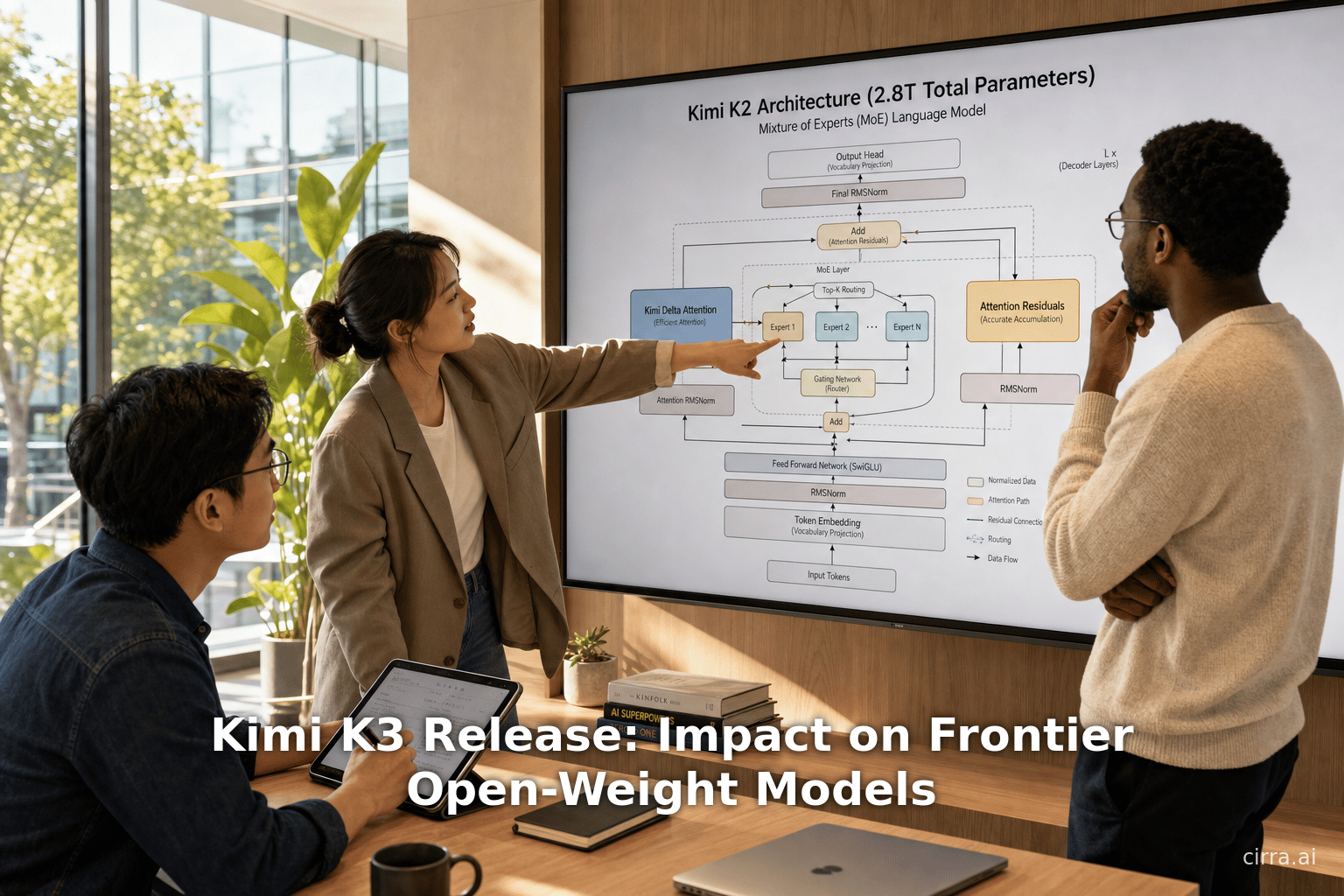
Kimi K3 runs on two architectural innovations Moonshot calls Kimi Delta Attention (KDA) and Attention Residuals (AttnRes), paired with a sparse Stable LatentMoE design that activates just 16 of 896 experts per token [7]. DeepLearning.AI's newsletter The Batch estimates that level of sparsity corresponds to roughly 50 billion active parameters per token [8]. The model natively processes text, images, and video across a 1 million token context window [9], and Moonshot reports that its architectural changes deliver roughly 2.5 times better scaling efficiency than its predecessor, Kimi K2, a claim DeepLearning.AI corroborated by noting the changes "made training about 2.5 times as efficient as its predecessor's training runs" [10]. Access to the hosted model opened immediately via Kimi.com, the Kimi Work desktop app, the Kimi Code CLI, and the Kimi API [11], priced at $3.00 per million input tokens, $15.00 per million output tokens, and a discounted $0.30 per million for cache hit input [12]. Moonshot has committed to publishing the full model weights by July 27, 2026, which would make Kimi K3 the largest open weight model ever released to the public [13].
The reaction was immediate and reveals how differently investors and analysts read the release. Shares in domestic rivals Z.ai and MiniMax fell roughly 27 percent and 16 percent respectively in Hong Kong trading on the news [14] [15], while several analysts drew direct comparisons to the market shock triggered by DeepSeek's R1 release in January 2025, an event that wiped out roughly $1 trillion in technology company value [16]. Not everyone agreed the reaction was proportionate: Moor Insights and Strategy's Patrick Moorhead called the response "an over-reaction shockingly similar the DeepSeek panic" [17]. The release also arrived amid geopolitical friction: a White House official later accused Moonshot of accessing restricted Nvidia GB300 chips through servers in Thailand and of distilling Anthropic's Fable model during K3's development, claims that fed into a broader Washington debate over export controls and "distillation" of American models by Chinese labs [18].
For enterprise buyers, the practical takeaway is that the price to performance gap between open weight and closed frontier models has narrowed sharply. Kimi K3's cost per completed task on the Artificial Analysis Intelligence Index runs about $0.94, close to GPT-5.6 Sol's $1.04 and roughly half of Claude Opus 4.8's $1.80, though still well above cheaper open peers like DeepSeek V4 Pro at $0.04 [19]. One widely-upvoted Reddit commenter did the same math on list pricing, noting Kimi K3 is "basically half the cost of sol and around a third of fable" [20]. Independent researchers caution that many of Moonshot's headline benchmark numbers were run in-house or with the company's own Kimi Code harness, and that Terminal-Bench 2.1's publicly posted leaderboard still lists a lower score than Moonshot's self-reported 88.3, underscoring the need to distinguish vendor claims from independently reproduced results [21]. This report examines what changed with Kimi K3, how it compares with DeepSeek and other open weight contenders, what the verified benchmark and pricing data show, and what the release implies for the broader open weight versus closed source debate as of July 2026.
Introduction and Background
Kimi K3 is the newest flagship large language model from Moonshot AI, a Chinese artificial intelligence startup founded in March 2023 [22] and backed by Alibaba, Tencent, Meituan, and HSG, the former Sequoia China [23]. Announced on July 16, 2026 and demonstrated publicly at WAIC in Shanghai on July 17, where "people visit the Moonshot AI stand, featuring Kimi K3," according to Getty Images captioning reproduced by the BBC [24], the model carries 2.8 trillion parameters, a measure of the number of adjustable weights inside the neural network that roughly correlates with capacity for complex reasoning [25]. Notably, Fortune's initial coverage cited a slightly different figure of 2.7 trillion parameters [26], a discrepancy this report notes rather than resolves, since the 2.8 trillion figure is what most subsequent outlets, including MarkTechPost, settled on [27].
The term open weight describes a model whose trained parameters are published for anyone to download, inspect, fine tune, and self host, in contrast to a closed source model such as GPT-5.6 Sol or Claude Fable 5, which can only be accessed through a vendor's hosted application programming interface (API) under usage terms the vendor controls [28]. This distinction matters commercially: open weight models let enterprises avoid per-token vendor lock-in and modify behavior directly, at the cost of needing their own GPU infrastructure and technical expertise to serve a model of this scale [29].
Kimi K3 did not appear in isolation. Moonshot officially released Kimi to the general public on November 16, 2023, based on the original Moonshot model, supporting a then-groundbreaking 128,000 token lossless context window [30]. On January 20, 2025, the company released Kimi K1.5, which it claimed "matched the performance of OpenAI o1 in mathematics, coding, and multimodal reasoning capabilities" [31]. Moonshot released the 1 trillion parameter Kimi K2 as an open weight model under a modified MIT license in July 2025 [32], followed by the multimodal, agent-capable Kimi K2.5 in January 2026 [33], the 256,000 token context Kimi K2.6 in April 2026 [34], and the coding specialist Kimi K2.7 Code in June 2026 [35]. That cadence reflects a deliberate strategic pivot: Moonshot's market position had eroded sharply after DeepSeek's R1 model disrupted the Chinese AI landscape in January 2025, with Kimi's ranking among Chinese chatbots by monthly active users sliding from third to seventh [36]. Kimi K3 represents the culmination of an 18 month recovery effort built on open sourcing and architectural efficiency rather than raw compute scale [37].
This report synthesizes verified reporting, Moonshot's own technical disclosures, and independent benchmark evaluations to answer what Kimi K3 is, how it compares against DeepSeek and other open weight contenders, what its pricing and API access look like, and what the release means for the broader frontier open weight model landscape heading into the second half of 2026.
Table 1 below traces Moonshot's model lineage from the original Kimi chatbot through Kimi K3, to give context for how quickly the company has scaled parameter count and capability.
| Version | Release Date | Parameters | Notable Feature |
|---|---|---|---|
| Kimi (original) | November 2023 | not disclosed | 128,000 token lossless context, first of its kind [38] |
| Kimi K1.5 | January 2025 | not disclosed | Claimed to match OpenAI o1 on math and coding [39] |
| Kimi K2 | July 2025 | 1 trillion (32B active) | First open weight flagship, modified MIT license [32] |
| Kimi K2.5 | January 2026 | 1 trillion (32B active) | Multimodal vision-language with agentic paradigms [40] |
| Kimi K2.6 | April 2026 | 1 trillion class | 256K context, stronger long-context code generation [41] |
| Kimi K2.7 Code | June 2026 | 256K context | Coding specialist, thinking mode required [42] |
| Kimi K3 | July 16, 2026 | 2.8 trillion (16 of 896 experts) | KDA and AttnRes, 1M context, native vision [43] |
As the table shows, Kimi K3 nearly triples the parameter count of Kimi K2 within a single year, a pace of scaling that stands out even against an already fast release cadence. The jump from K2's 32 billion active parameters and 128,000 to 256,000 token context windows to K3's estimated 50 billion active parameters and 1 million token window illustrates how much of Moonshot's engineering effort over the past year targeted both raw scale and long-context efficiency simultaneously.
Key Changes: What Kimi K3 Actually Changes
Scale: A 2.8 Trillion-Parameter Model Announced as Open-Weight
The headline number is scale. At 2.8 trillion total parameters, MarkTechPost reported that "Moonshot team states K3 is the first open model to reach 2.8 trillion parameters," extending a pattern in which "for nine of the past twelve months, Kimi models set the upper bound of open-model sizes" [44]. VentureBeat calculated that this makes K3 roughly 75 percent larger than DeepSeek's V4 Pro, which the company's own comparative chart places at approximately 1.6 trillion parameters [45]. For scale context, VentureBeat's reporting on Moonshot's internal chart also placed Xiaomi's largest open model at roughly 1.02 trillion parameters and Alibaba's at 397 billion, both well below Kimi K3 [46].
Raw parameter count, however, is not the same as active compute per token. Kimi K3 is a sparse mixture of experts (MoE) model that activates only 16 of its 896 experts for any given token, which DeepLearning.AI's newsletter The Batch estimates corresponds to roughly 50 billion active parameters at inference time [8]. Moonshot has not disclosed the exact active parameter count, listing it among the details still pending in its forthcoming technical report [47]. Just three days after Kimi K3's launch, Alibaba, a Moonshot financial backer, previewed Qwen3.8-Max-Preview, an early 2.4 trillion parameter model the company claims trails only Claude Fable 5, which suggests the parameter race among Chinese labs is intensifying rather than settling [48].
Architecture: Kimi Delta Attention and Attention Residuals
The architectural core of Kimi K3 rests on two innovations Moonshot developed internally and had previously published as open research: Kimi Delta Attention (KDA), a hybrid linear attention mechanism, and Attention Residuals (AttnRes), a replacement for standard residual connections between transformer layers [49]. DeepLearning.AI explains that KDA "maintains a fixed-size memory that updates as it reads input" rather than comparing every new token against every previous token, deciding for each value of that memory "when to overwrite old information" [50], and that in an earlier experimental model called Kimi Linear, KDA "cut memory use by up to 75 percent and multiplied output speed by up to 6 times at input lengths of 1 million tokens" [51]. Separately, MarkTechPost reports Moonshot's own claim that KDA "enables up to 6.3x faster decoding in million-token contexts" [52].
Where standard residual connections add every layer's output to a running total with equal weight, "so each layer's individual contribution dilutes with more layers," AttnRes applies attention across model depth so that "each layer learns to draw selectively on the outputs of earlier layers, much as standard attention draws selectively on earlier tokens" [53]. DeepLearning.AI notes that the block-level variant Kimi K3 actually uses "matched the performance of a model with standard residual connections but used 20 percent less training compute" in Moonshot's own earlier experiments [54], while MarkTechPost separately reports Moonshot's figure that AttnRes "delivers roughly 25% higher training efficiency at under 2% additional cost" [55].
Layered on top of KDA and AttnRes is a design Moonshot calls Stable LatentMoE, alongside four supporting techniques. MarkTechPost's summary explains that "Quantile Balancing derives expert allocation directly from router-score quantiles," eliminating "heuristic updates and a sensitive balancing hyperparameter," while "Per-Head Muon extends Muon by optimizing attention heads independently," and "Sigmoid Tanh Unit (SiTU) and Gated MLA improve activation control and attention selectivity respectively" [56]. DeepLearning.AI summarized the combined effect: these changes, together with a sparser MoE design and improved training recipes, made training "about 2.5 times as efficient" as Kimi K2's training runs, measured in model improvement per unit of compute [57]. For serving, Moonshot applies quantization-aware training using MXFP4 weights with MXFP8 activations, and NxCode's independent review confirms the launch materials recommend "a supernode with at least 64 accelerators for deployment" [58].
Multimodality and the 1 Million Token Context Window
Kimi K3 processes text, images, and video natively within a single model, backed by a context window of up to 1,048,576 tokens, roughly 1 million tokens, for both input and output [9]. DeepLearning.AI's evaluation notes Kimi K3 can output roughly 62.0 tokens per second in text generation [59], a figure that Artificial Analysis's independent testing found runs somewhat below the comparison median of roughly 72 tokens per second among peer models [60]. Moonshot describes the model as achieving "vision in the loop," meaning it can iterate between generated code and live screenshots to refine visual outputs, which SiliconANGLE reports "makes it especially useful for tasks such as games development, user interface design and computer-aided design" [61].
Independent field testing found this vision capability uneven in practice. In one Reddit discussion on the r/kimi community, a user working with Bloomberg terminal screenshots and data tables reported that K3 "would shift columns within a perfect screenshot, thus rendering the spreadsheet useless," ultimately routing image transcription through Google's Gemini 3.1 Pro before feeding the resulting CSV data into K3 [62]. The same user found K3 "even on standard thinking is still very very slow" [63] and that in market analysis contexts it was "long-winding and less concise" than Claude Opus 4.8, concluding that "Fable 5 is still the sharpest AI analyst" among available systems [64]. This kind of qualitative feedback, while anecdotal, is a useful counterweight to vendor benchmark tables and is discussed further in the reception subsection below.
Benchmark Performance: Where Kimi K3 Sits Relative to Frontier Models
Moonshot's own evaluation suite, run at maximum reasoning effort, positions Kimi K3 as trailing only Claude Fable 5 and GPT-5.6 Sol, a framing MarkTechPost summarized directly: "Overall performance still trails the most powerful proprietary models, Claude Fable 5 and GPT 5.6 Sol. Across Moonshot's own evaluation suite, K3 consistently outperformed other tested models" [65]. Independent verification from Artificial Analysis corroborates the broad shape of that claim: Kimi K3 scored 57 on the Intelligence Index (a composite of nine evaluations of economically useful tasks) compared with 60 for Claude Fable 5 with fallback and 59 for GPT-5.6 Sol, while the next-closest open weights model, GLM-5.2, scored 51 [66].
On agentic and knowledge-work evaluations, Kimi K3 reached an Elo rating of 1,668 on GDPval-AA v2 (a private Artificial Analysis benchmark drawn from real-world tasks across 44 occupations and nine major industries), trailing Claude Fable 5's 1,760 but ahead of GPT-5.5 (1,494), GLM-5.2 (1,514), and Claude Opus 4.8 (1,600) [67]. VentureBeat's independent tally of the same benchmark used slightly different absolute figures, reporting K3 "scored 1,687, placing it third overall, behind only Claude Fable 5 Max (1,815) and GPT-5.6 Sol Max (1,747.8), and ahead of Claude Opus 4.8 (1,600)" [68], a discrepancy likely reflecting different snapshot dates of a benchmark Artificial Analysis continues to update. On AA-Briefcase, a private long-horizon knowledge-work evaluation, Kimi K3 reached an overall Elo of 1,547, a gain of 732 points over its predecessor Kimi K2.6, and second only to Claude Fable 5 [69]. Kimi K3 also took the top position on AutomationBench-AA, Artificial Analysis's implementation of a Zapier-style agentic software workflow evaluation, with a score of 53 percent [70], and VentureBeat separately reported it ranked "first in four out of eight benchmarks" of real-world task automation tested by Moonshot [71].
On developer preference, Kimi K3 debuted at the top of Arena.ai's Code Arena WebDev leaderboard with a preliminary rating of 1,679, outpacing both Claude Fable 5 and GPT-5.6 Sol and placing first in six of seven measured frontend domains [72]. Arena chief executive Anastasios Angelopoulos called it "the single biggest release of the year, and marks the moment that OSS Chinese models have surpassed US models," adding that on Code Arena "Kimi K3 has BEATEN FABLE" only six weeks after Fable's own release [73]. Moonshot separately reported a state-of-the-art score of 91.2 out of 100 on BrowseComp, a long-horizon information-seeking benchmark, achieved using the model's full 1 million token context window without any context compaction, a result VentureBeat called "perhaps most impressively" among K3's launch numbers [74], while the version tested under the context compaction methodology used for direct comparisons scored 90.4, according to MarkTechPost's footnote on Moonshot's methodology [75].
Independent scrutiny of these results is important. The developer analysis outlet NxCode noted that Moonshot's mixed-harness methodology, evaluating K3 with its own Kimi Code agent tool while comparing rival models under Claude Code or Codex, complicates apples-to-apples comparison, and flagged that "Artificial Analysis's Terminal-Bench page describes its results as independent and currently lists 84.6 as the leading published score," compared with Moonshot's self-reported 88.3 for K3 on that benchmark [21]. NxCode also cautioned that ProgramBench's 77.8 figure is "raw hidden-test pass rate, not the much stricter 'fully resolved' task rate," meaning "K3's number supports broad behavioral reconstruction skill; it does not mean K3 rebuilt 77.8% of the programs perfectly" [76]. NxCode's overall assessment was that Kimi K3 "now has enough benchmark evidence to justify a serious engineering evaluation" but "does not yet have enough same-harness, independently reproduced evidence to justify a universal 'best coding model' claim," a distinction this report treats as the responsible reading of the available data [77].
Table 2 below summarizes Moonshot's published multi-benchmark comparison across coding and reasoning tasks, drawing on the company's official benchmark table as independently reproduced by MarkTechPost.
| Benchmark | Kimi K3 | Claude Fable 5 (w/ fallback) | GPT-5.6 Sol | Claude Opus 4.8 | GLM-5.2 |
|---|---|---|---|---|---|
| DeepSWE (issue repair) | 67.5 | 70.0 | 73.0 | 59.0 | 46.2 |
| ProgramBench (raw pass rate) | 77.8 | 76.8 | 77.6 | 71.9 | 63.7 |
| Terminal-Bench 2.1 | 88.3 | 84.6 | 88.8 | 84.6 | 82.7 |
| FrontierSWE (dominance) | 81.2 | 86.6 | 71.3 | 66.7 | 67.3 |
| SWE Marathon | 42.0 | 35.0 | 39.0 | 40.0 | 13.0 |
| BrowseComp | 91.2 | 88.0 | 90.4 | 84.3 | not reported |
| Automation Bench | 30.8 | 29.1 | 29.7 | 27.2 | 12.9 |
| GPQA-Diamond | 93.5 | 92.6 | 94.1 | 91.0 | 91.2 |
Source: Moonshot AI's Kimi K3 technical blog, as tabulated by MarkTechPost [78]. As the table shows, Kimi K3 does not lead every category. It trails GPT-5.6 Sol on DeepSWE and Claude Fable 5 on FrontierSWE, but it leads on ProgramBench, SWE Marathon, BrowseComp, and Automation Bench, a pattern MarkTechPost summarized as K3 leading "Program Bench, SWE Marathon, BrowseComp, Automation Bench, and OmniDocBench" while trailing "Fable 5 on FrontierSWE and HLE-Full, and GPT 5.6 Sol on DeepSWE" [79]. The overall pattern supports Moonshot’s launch-period framing that K3 was competitive with the leading closed models on several evaluations, rather than a universal leader. By July 26, Artificial Analysis’s later Intelligence Index update placed Opus 5 (61), Fable 5 (60), and GPT-5.6 Sol (59) ahead of K3 (57), while K3’s open-weight standing remained contingent on publication of its weights ( Artificial Analysis; Moonshot AI.
Kimi K3 vs DeepSeek: A Planned Open-Weight Challenger and an Open-Weight Leader
The most frequent head-to-head comparison readers search for is Kimi K3 against DeepSeek. As of July 2026, the relevant DeepSeek comparison point is DeepSeek V4 Pro, not the older DeepSeek-V3 model from December 2024, which remains a common but outdated reference point in several automated comparison tools [80]. VentureBeat's reporting places DeepSeek V4 Pro at approximately 1.6 trillion parameters, well below Kimi K3's 2.8 trillion [81]. On the Artificial Analysis Intelligence Index, DeepSeek V4 Pro at maximum reasoning effort scores 44, compared with Kimi K3's 57, and Artificial Analysis's own article states plainly that once weights are released "Kimi K3 would clearly lead other open weights models including GLM-5.2 (51) and DeepSeek v4 Pro (44)" [82]. The price difference is the other side of the story: DeepSeek V4 Pro's Artificial Analysis cost per Intelligence Index task is just $0.04, versus $0.94 for Kimi K3, roughly a 23-fold difference, with Artificial Analysis noting Kimi K3 is "more expensive than open weights peers, GLM-5.2 ($0.32) and DeepSeek V4 Pro ($0.04)" [83].
Fortune's coverage independently confirmed the cost gap using list pricing: Kimi K3 costs $15 per million output tokens, compared with $0.87 for DeepSeek V4, positioning DeepSeek as the far cheaper but less capable option [84]. Kimi K3 also holds a decisive multimodal and context advantage: llm-stats.com's side-by-side comparison found "Kimi K3 supports multimodal inputs, whereas DeepSeek-V3 does not" [85], and that "Kimi K3 accepts 1,048,576 input tokens compared to DeepSeek-V3's 131,072 tokens" [86]. One Reddit user framed the tradeoff bluntly during the launch discussion, noting that Kimi K3 delivers "Fable lvl performance with less than half the parameter size" of some closed frontier systems, an observation that speaks to the efficiency of Moonshot's architecture even if the comparison to DeepSeek specifically runs the other direction on price [87]. The practical framing that emerges from independent coverage is that DeepSeek remains the value option for cost-sensitive, high-volume workloads, while Kimi K3 targets buyers willing to pay a premium for higher benchmark ceilings, native vision, and a substantially longer context window.
Pricing and API Access
Kimi K3 is available today through four channels: the Kimi.com consumer chat interface, the Kimi Work desktop application, the Kimi Code command-line coding agent, and the first-party Kimi API, which DeepLearning.AI lists simply as available "via Kimi.com, Kimi mobile apps, Kimi Work app, and Kimi Code CLI" [11]. API pricing is flat regardless of context length: $0.30 per million tokens for cache-hit input, $3.00 per million tokens for cache-miss input, and $15.00 per million tokens for output, including reasoning tokens [88]. SiliconANGLE's independent read of the API documentation confirms the same structure: "priced at 30 cents per 1 million input tokens with a cache hit and $3 without. One million output tokens, including reasoning, cost $15" [89]. NxCode's independent testing confirmed Moonshot's cache infrastructure claims, noting the company "says its official API sees cache-hit rates above 90% in coding workloads," which materially lowers effective cost for repository-heavy agentic sessions that repeat context across turns [90].
Table 3 below places Kimi K3's list pricing alongside its closest rivals to make the cost gap concrete.
| Model | Input price (per 1M tokens) | Output price (per 1M tokens) | Notes |
|---|---|---|---|
| Kimi K3 | $3.00 ($0.30 cache hit) | $15.00 | Flat pricing regardless of context length [91] |
| Z.ai GLM-5.2 | not disclosed in sourced reporting | $4.40 | Cited by Fortune as roughly a third of K3's output price [92] |
| DeepSeek V4 | not disclosed in sourced reporting | $0.87 | Cheapest of the compared models on output tokens [93] |
| Claude Fable 5 | $1.00 | $50.00 | Roughly 3.3 times K3's output price [94] |
| GPT-5.6 Sol | $0.50 | $30.00 | Roughly 2 times K3's output price [95] |
Kimi K3’s output-token price sits between the ultra-cheap Chinese tier represented here by DeepSeek and GLM-5.2 and the listed output prices of Claude Fable 5 and GPT-5.6 Sol. On standard input pricing, K3’s $3.00-per-million rate is lower than Claude Fable 5’s $10.00 and GPT-5.6 Sol’s $5.00 ( Anthropic; OpenAI. Fortune summarized the position bluntly: "K3 is expensive, by Chinese standards," yet "it's cheaper than the equivalent U.S. models" [96]. Constellation Research analyst Holger Mueller framed the pricing as one of three defining traits of the release: "it is the largest open weight model released, it is multimodal from a visual feedback perspective and it is priced cheaper than the other leading models in the space" [97]. Developer integration is straightforward: MarkTechPost's walkthrough confirms the API is compatible with the OpenAI SDK against a Moonshot base URL, and that the reasoning_effort parameter "supports only max, and the K2.x thinking parameter must not be used" at launch [98]. Consumer subscription access through the Kimi app ranges from a free tier to $199 per month [99].
Implementation Considerations and Process Changes
Enterprises evaluating Kimi K3 face several practical constraints that distinguish it from a typical API switch. First, Moonshot has not yet released the model's weights: as of the July 26, 2026 publication date of this report, K3 remains accessible only through Moonshot's hosted API and applications, with full weights promised by July 27, 2026, a commitment DeepLearning.AI notes "would make Kimi K3 the largest known open weights model to date" once fulfilled [13]. Until that release, self-hosting is not possible, and NxCode observed that "Artificial Analysis labels K3 proprietary because the weights were not public on July 17," a useful reminder that "open weight" claims should be verified against actual publication dates rather than launch announcements [100].
Second, Moonshot's own disclosed limitations list two behavioral quirks that implementation teams should account for. Kimi K3 was trained with "preserved thinking history," meaning that if an agent harness fails to pass back the model's full historical reasoning, or if a session is switched mid-stream from another model to K3, "generation quality may become highly unstable" [101]. Moonshot recommends using a verified-compatible harness such as its own Kimi Code tool for this reason. The model is also described as exhibiting "excessive proactiveness," meaning that on ambiguous tasks "it may make unexpected decisions on the user's behalf" [102], which Moonshot advises mitigating with explicit behavioral constraints in the system prompt or an AGENTS.md file. Moonshot's own launch materials are candid that, "despite being a highly competitive model overall, K3 nonetheless exhibits a noticeable gap in user experience compared with Claude Fable 5 and GPT 5.6 Sol" [103].
Third, cost architecture requires workflow-level accounting rather than simple per-token comparison. NxCode's guidance for engineering teams recommends tracking cache-hit input, cache-miss input, output, and retry costs separately, then dividing total spend by accepted tasks rather than attempted ones, since "a $12 successful run can be preferable to three $4 failures" [104]. NxCode further cautions that "a model that resolves 5% more tasks but doubles review time and triples cost may be worse for the workflow," reinforcing that raw benchmark leadership does not automatically translate into the most economical production choice [105]. Recommended adoption steps for a controlled evaluation include:
- Freeze the environment: NxCode's adoption playbook recommends teams "pin repository commits, model identifiers, Kimi Code version, system policy, dependencies, and test images" before any comparative testing begins [106].
- Match the benchmark to the workload: dependency migrations map to DeepSWE-style evaluations, while binary reconstruction tasks map more closely to ProgramBench.
- Run blinded trials: NxCode recommends that "reviewers should see diffs and evidence but not model labels" when comparing outputs across candidate models [107].
- Track cost per accepted task, not raw solve rate, since a premium model that reduces review time can still be more economical overall.
- Limit autonomous authority: given Moonshot's own warning about excessive proactiveness, restrict K3's access to deployment systems and secrets during early trials.
- Verify harness compatibility: confirm that any coding agent framework correctly preserves and replays K3's full thinking history between turns.
Fourth, Moonshot recommends serving infrastructure with 64 or more accelerators per supernode for production deployment at this parameter scale, a nontrivial infrastructure commitment that keeps self-hosting realistic mainly for organizations with substantial GPU fleets once weights are published [58]. That infrastructure investment sits on top of Moonshot's own serving research: the company's Mooncake project, which VentureBeat notes "won the Best Paper award at FAST 2025," pioneered "KV-cache-centric disaggregated serving for large language models," an architecture explicitly designed to make inference at extreme scale more practical and cost-efficient [108]. Alongside K3, Moonshot's open-source Kimi Code CLI, which VentureBeat describes as competing "with Anthropic's Claude Code and Google's Gemini CLI," had accumulated more than 3,100 stars on GitHub by launch day, with same-day releases of versions 0.25.0 and 0.26.0 "adding features like expanded subagent tooling, background task management, and security fixes" [109]. Finally, buyers operating in regulated or security-sensitive US contexts should track the ongoing distillation and export control dispute discussed later in this report, since policy responses to Kimi K3's release could affect future access to Chinese open weight models generally.
Data Analysis and Evidence
The quantitative picture around Kimi K3 spans four distinct areas: independent benchmark measurement, operating cost and efficiency data, broader market adoption trends for Chinese open weight models, and corporate financial disclosures. On the benchmark side, Artificial Analysis's independent Intelligence Index, a composite of nine evaluations including GDPval-AA v2, Terminal-Bench 2.1, SciCode, Humanity's Last Exam, and GPQA Diamond, scored Kimi K3 at 57, versus 60 for Claude Fable 5 with fallback, 59 for GPT-5.6 Sol, 51 for GLM-5.2, and 44 for DeepSeek V4 Pro at maximum reasoning effort [82]. Token efficiency improved materially generation over generation: Kimi K3 used approximately 132 million output tokens to complete the full nine-evaluation Intelligence Index suite, a 21 percent reduction from the roughly 166 million tokens Kimi K2.6 required, while scoring higher overall [110].
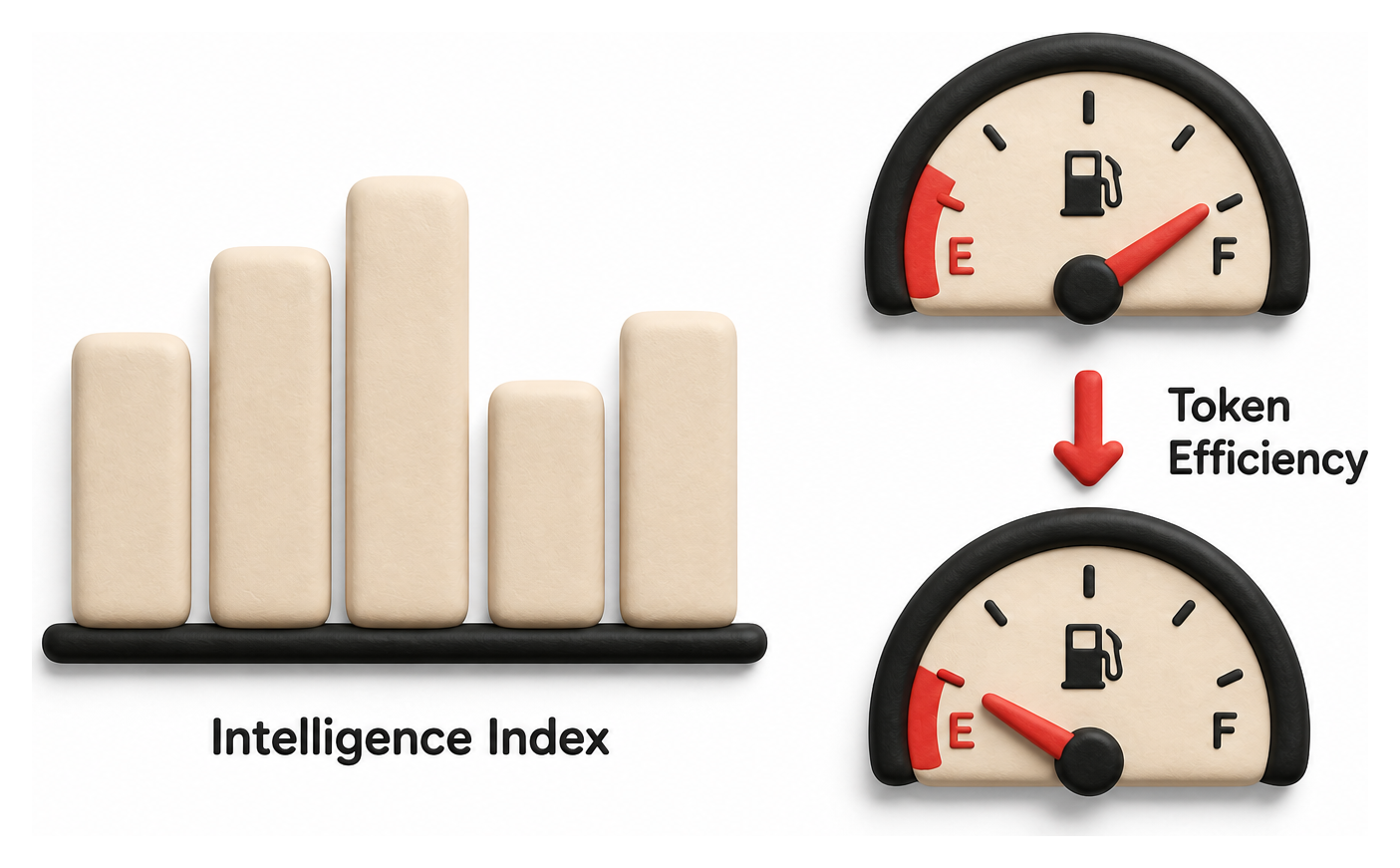
Not every metric improved. Artificial Analysis's AA-Omniscience Index found Kimi K3's accuracy rate climbed from 33 percent to 46 percent relative to K2.6, but its hallucination rate also rose, from 39 percent to 51 percent, a tradeoff the firm flagged explicitly rather than obscuring [111]. On raw operating characteristics, Artificial Analysis's evaluation run measured Kimi K3 generating 62 output tokens per second (below a roughly 72 tokens-per-second peer median), consuming about 130 million output tokens across its full evaluation suite (versus a roughly 63 million token peer median), and totaling $2,690.80 in evaluation cost [112].
Market-level data reinforces the direction of travel toward cheaper, Chinese-made open weight models generally. CNBC reported, citing OpenRouter data, that the share of tokens used by US companies on Chinese AI models has sat above 30 percent every week since February 8, 2026, peaking as high as 46 percent, compared with an average of just 11 percent over the prior twelve months and 4.5 percent in the first half of 2025 [113]. OpenRouter's Justin Summerville told CNBC that open source Chinese models can run "60% to 90% cheaper" than leading Anthropic and OpenAI systems [114]. Reuters reporting corroborates this shift structurally, noting that on the Arena benchmarking platform "the top eight open-source AI models for agent-based tasks are made by Chinese developers, as are the top 17 open-source models for coding tasks" [115]. Brookings fellow Kyle Chan estimated that Chinese models overall run "six to nine months" behind the top US frontier systems while remaining "a fraction of the cost" [116], a gap Kimi K3's benchmark performance appears to have narrowed further on several specific tasks even if it has not closed it entirely. Vercel's head of agentic infrastructure, Harpreet Arora, described a related dynamic around another Chinese release, GLM-5.2, noting that "in its first full week after launch, daily token volume grew about 27x and the number of customers using it grew about 80x," illustrating how quickly enterprise workloads can shift toward a cheaper, capable open model once it is proven in production [117].
On corporate financials, Moonshot raised $2 billion in a Meituan-led round in May 2026 at a valuation exceeding $20 billion, according to reporting cited by CNBC [118]. VentureBeat separately reported the company had earlier raised "roughly $1.5 billion across multiple rounds" as its valuation climbed toward that figure [119]. TechCrunch reported the company was subsequently in discussions for a fresh round that would value it at $31.5 billion [120], and Fortune reported a financial advisor's statement that Moonshot's annual recurring revenue had exceeded $200 million [121]. Market reaction to the K3 launch was sharply negative for domestic competitors, with Z.ai shares falling roughly 27 to 28 percent and MiniMax Group shares falling about 16 percent on the Hong Kong exchange the day of the announcement [15]. Chinese state news agency Xinhua framed the release as a national milestone, and VentureBeat reported that a Moonshot executive explained the significance of the parameter count by comparing it to neural connections in the human brain, stating that nearly 3 trillion of them means the model can "store more knowledge and patterns in its brain, understand more, think deeper, and answer more accurately" [122].
Case Studies and Real-World Examples
Case 1: A 48-Hour Autonomous Chip Design Proof of Concept
Moonshot demonstrated Kimi K3 designing a physical chip intended to run a nano-scale version of itself, a demonstration VentureBeat reported involved the model "tasked with designing a physical chip to run a nano-scale version of itself" over "48 hours of continuous autonomous agent operation" [123]. Using open-source electronic design automation (EDA) tools on the Nangate 45nm library, the model built, optimized, and verified a chip design that VentureBeat described as "just 4 square millimeters, that achieved timing convergence at 100 MHz and could decode more than 8,700 tokens per second in simulation" [124]. VentureBeat's independent framing described the exercise as "not a production chip" but a clear demonstration of "what Moonshot AI clearly views as the next competitive frontier: long-range autonomous agent capabilities" [125].
Case 2: MiniTriton, a From-Scratch GPU Compiler
Moonshot also tasked Kimi K3 with building a GPU programming system from scratch, resulting in MiniTriton, described in Moonshot's own technical blog as "a compact Triton-like compiler with its own tile-level IR layer over MLIR, optimization passes, and a PTX code-generation pipeline" [126]. Moonshot reports that across supported roofline benchmarks, MiniTriton "delivers performance on par with or better than Triton and torch.compile, beating Triton on certain workloads," and sustains end-to-end nanoGPT training with stable convergence [127]. This case demonstrates capability building infrastructure tooling rather than merely using existing tools, a distinction relevant to enterprises considering K3 for internal platform engineering rather than only application coding.
Case 3: Reproducing the I-Love-Q Universal Relations in Astrophysics
In a research-reproduction case study, VentureBeat reported that Kimi K3 "reportedly reproduced the universal I-Love-Q relation, a complex calculation that typically takes a senior researcher one to two weeks, in approximately two hours, reading and cross-validating more than 20 papers and implementing a complete numerical pipeline" [128]. This case, alongside the chip design and MiniTriton examples above, illustrates a common thread in Moonshot's launch materials: framing Kimi K3 not merely as a chat assistant but as a long-horizon autonomous agent capable of multi-day technical projects with minimal human supervision.
Case 4: Adoption by Cursor, DoorDash, and Thinking Machines
Beyond Moonshot's own demonstrations, third-party adoption of the Kimi model family provides independent evidence of commercial traction. Fortune reported that the AI-assisted coding startup Cursor "used Kimi to help build Composer 2, its AI coding agent" [129], while DoorDash chief technology officer Andy Fang stated in a social media post that the company "delegates lower-level work to Kimi K2.6" [130]. Fortune additionally reported that Thinking Machines, the AI lab co-founded by Mira Murati, used Kimi K2.5 "to generate early post-training data" for its own Inkling model, released July 15, 2026 [131]. Artificial Analysis's own subsequent evaluation of Inkling found it "scores an Elo of 836 on our agentic knowledge work benchmark AA-Briefcase," a useful independent reference point for a model partly trained using Kimi-generated data [132]. These cases show the Kimi model family being used both as a production inference layer and as a training data source for other labs' models, a dual role that speaks to the ecosystem depth Moonshot has built well before K3's release.
Case 5: Market Reaction and the Distillation Dispute
The clearest real-time market response to Kimi K3 came from Chinese competitors' equity prices: Z.ai shares fell roughly 27 to 28 percent and MiniMax Group shares fell about 16 percent in Hong Kong trading the day of the announcement [133]. Seven days after the launch, a White House official escalated the story into a policy dispute. Michael Kratsios, director of the White House Office of Science and Technology Policy, wrote on X that Moonshot "acquired GB300-equipped servers and has accessed GB300s in Thailand, likely to train its AI models," despite US export restrictions on Nvidia's advanced chips [134]. Kratsios further stated that "we have information that Moonshot AI distilled Anthropic's Fable for the development of its K3 model" [135], and Treasury Secretary Scott Bessent warned that "when PRC firms conduct covert, industrial-scale distillation attacks that cross the line into IP theft, sanctions and Entity List designations will be on the table" [136]. A spokesperson for the UK embassy of the People's Republic of China previously told CNBC that the country "opposes baseless allegations and malicious smears against its AI development" [137]. This case underscores that Kimi K3's technical achievement cannot be separated from the geopolitical context in which it was released.
Case 6: Community Reception on Developer Forums (Sentiment)
Reception on developer-focused forums has been more mixed than Moonshot's own benchmark claims suggest, and is worth reading as sentiment rather than verified performance data. On the enthusiast side, one Reddit user testing K3's game-character animation capability on r/kimi reported that after feeding it a demanding Three.js procedural-animation prompt, "kimi k3 kept working till it gives this masterpiece" after working for a straight four hours, concluding simply "It's an insane model" [138] [139].
Reaction on r/singularity to Moonshot's benchmark chart was similarly split between excitement and skepticism. One highly-upvoted comment framed the release starkly: "So either (a) it's mega benchmaxxed or (b) the public frontier of open weights and Chinese models has caught up with the frontier of closed-source American models. This is actually shocking" [140]. Another user was more cautious, writing "Dunno. Gave it my test prompt and the output was a far cry from what Sol and Fable are able to produce. Let's see what independent benchmarks say and what users report after a few days running the model. The latest massively hyped up Chinese models all turned out mixed bags in the end" [141]. Another commenter wryly noted the policy tension the release created: "The White House must be having a real hard time figuring out how to put an export block on something that isn't their product" [142]. This spread of reactions, ranging from "It's an insane model" to warnings that hyped Chinese releases "all turned out mixed bags in the end," illustrates why this report treats independent benchmark data as more decisive than either enthusiastic or skeptical anecdotal impressions.
Implications and Future Directions
Kimi K3's release accelerates several trends already underway in the frontier model market. First, the price-performance gap between open weight and closed source frontier systems has compressed meaningfully. DeepLearning.AI's analysis concluded that Kimi K3 "whittles away at every reason why a developer choosing a model might default to the top proprietary model," performing within three points of Claude Fable 5 on the Intelligence Index "at a much lower cost per task," and noted that "competition this close, on price, control, and performance, pressures proprietary developers to deliver better, cheaper models" [143]. This dynamic already appears to be reshaping vendor strategy: Anthropic's own Claude Opus 5, released July 24, 2026, was positioned partly as a response, with Artificial Analysis reporting that "Claude Opus 5 is narrowly the most intelligent model on the Artificial Analysis Intelligence Index, offering comparable intelligence to Fable 5 at 26% lower Cost per Task" and that Opus 5 (max) scores "61 on the Artificial Analysis Intelligence Index" versus Kimi K3's 57 [144] [145].
Second, control over usage policy becomes a meaningful differentiator once weights are public. DeepLearning.AI observed that "whoever owns those weights sets usage policies," meaning "many requests that Claude Fable 5 refuses won't cause friction for Kimi K3 users" once the model is self-hostable [146]. This raises governance questions for enterprises operating in regulated industries, who must weigh the flexibility of a self-hosted, policy-free model against the compliance guardrails a vendor-hosted closed system provides by default.
Third, the geopolitical dimension is likely to intensify rather than settle. Reuters reported that China itself is weighing a "silicon curtain" that would restrict overseas access to its own top AI models, describing how "Beijing has discussed restricting overseas access to homegrown AI models" even as Washington considers its own controls [147]. CNBC reported that the proposed Remote Access Security Act "seeks to expand U.S. export controls to include the remote cloud-based access of critical hardware and software" and had already passed the House of Representatives [148]. Hugging Face chief executive Clement Delangue warned that restricting access to Chinese open weight models "would be a terrible blow" to the thousands of US-based startups and researchers relying on them, and would "concentrate AI power even more in the hands of a few mega-corporations against whom it would be virtually impossible for anyone to compete" [149]. Delangue separately observed that OpenAI's own open-weight release "is nearly a year old, an eternity in AI timelines," while Western open model offerings "have not kept pace with the advanced capabilities" of recent Chinese releases [150].
Fourth, the release intensifies competitive pressure within China's own AI sector. Bank of America analyst Alex Liu wrote that "K3 raises the capability ceiling for China AI models, shifting the burden of proof to other independent AI labs" [151], while separately noting that "despite persistent hardware/compute capacity constraints in China, K3 demonstrates that pre-training scaling, paired with architectural innovation, can still deliver step-change gains for flagship Chinese models" [152]. Fusion Fund founder Lu Zhang cautioned against overreading the moment as purely a US-China story, noting that US labs including Thinking Machines and DeepReinforce are also releasing open weight models, and that it was "only a matter of time" before a model of this caliber emerged given how fast the field is moving [153]. Looking forward, the near-term signals to watch are whether Moonshot meets its July 27, 2026 weights release commitment on schedule, how independent benchmarks reconcile with Moonshot's self-reported numbers once community-run reproductions appear, and how policymakers in both Washington and Beijing respond to the distillation and chip-access allegations raised in the days following launch.
Frequently Asked Questions (FAQs)
What is Kimi K3? Kimi K3 is a 2.8 trillion parameter mixture of experts large language model released by Moonshot AI on July 16, 2026, built on the company's Kimi Delta Attention and Attention Residuals architecture, with native multimodal input and a 1 million token context window [1].
Is Kimi K3 better than DeepSeek? On Artificial Analysis's Intelligence Index, Kimi K3 (57) outscores DeepSeek V4 Pro (44) and leads on most published benchmarks, but DeepSeek V4 Pro costs roughly 23 times less per completed task, making the better choice workload-dependent rather than absolute [82].
Is Kimi K3 open source or open weight? Moonshot describes K3 as an open weight model, meaning the trained parameters will be publicly downloadable, with full weights promised by July 27, 2026, though the exact license terms were still undisclosed as of the model's launch [47].
How much does the Kimi K3 API cost? Kimi K3 is priced at $3.00 per million input tokens, $15.00 per million output tokens, and a discounted $0.30 per million for cache-hit input, with flat pricing regardless of context length [88].
Is Kimi K3 the best open weight LLM in 2026? As of July 2026, Kimi K3 leads the Artificial Analysis Intelligence Index among open weights models, ahead of GLM-5.2 (51) and DeepSeek V4 Pro (44), pending the release of its own weights, though Alibaba's preview of Qwen3.8-Max-Preview days later suggests this ranking could shift quickly [154] [155].
What is Moonshot AI? Moonshot AI is a Beijing-based artificial intelligence startup founded in March 2023 [22], backed by Alibaba, Tencent, Meituan, and HSG, which raised $2 billion at a valuation exceeding $20 billion in May 2026 [118].
Does Kimi K3 support images and video? Yes. Kimi K3 accepts native text, image, and video input, though independent user testing reported inconsistent performance reading dense data tables in screenshots [62].
How does Kimi K3 compare with DeepSeek on context window and pricing? Kimi K3 offers a 1,048,576 token context window against DeepSeek-V3's 131,072 tokens [86], while costing roughly $15 per million output tokens against DeepSeek V4's $0.87 [84].
Conclusion
Kimi K3 marks a significant, independently corroborated step toward frontier models announced for open-weight release. Its 2.8 trillion parameters and architectural efficiency gains from Kimi Delta Attention and Attention Residuals produced a score of 57 on the Artificial Analysis Intelligence Index. K3 was third in Artificial Analysis’s July 17 snapshot, but by this report’s July 26 publication date, Claude Opus 5 (61), Claude Fable 5 (60), and GPT-5.6 Sol (59) ranked ahead of it. If Moonshot released the promised weights, Artificial Analysis expected K3 to lead other open-weight models. The release nonetheless confirms that the performance gap between the best available or planned open-weight systems and top closed frontier models has narrowed to single-digit points on this composite benchmark ( Artificial Analysis, July 17; Artificial Analysis, July 24; Moonshot AI.
At the same time, the evidence gathered in this report supports a measured rather than triumphalist reading. Independent benchmark reproduction remains incomplete, Moonshot's own harness-dependent methodology complicates direct comparison on several coding tasks, real-world user feedback on vision and responsiveness is mixed, and the model's weights were not yet public at the time of this report's publication. The commercial and geopolitical stakes are also unusually high: Kimi K3 arrived amid active disputes over chip export controls, model distillation, and the broader question of how much of the global AI stack should run on Chinese open weight infrastructure.
For technology buyers, the practical guidance is to treat Kimi K3 as a serious, cost-competitive option for coding, agentic workflows, and long-context knowledge work once its weights are available, while running controlled, workload-specific evaluations rather than relying on vendor benchmark tables alone. For policymakers and market observers, Kimi K3 is best understood as one data point, albeit an important one, in a broader and accelerating contest over whether frontier AI capability will concentrate in a small number of closed, expensive systems or diffuse through openly available, continually improving alternatives. Given the pace of releases already following K3, including Alibaba's Qwen3.8-Max-Preview and Anthropic's own Claude Opus 5, this landscape is likely to look different again within months of this report's July 26, 2026 publication date.
External Sources (155)
About
Cirra AI
About Cirra AI
Cirra AI is a software company dedicated to reinventing Salesforce administration through AI-powered tooling built on the Model Context Protocol (MCP). From its headquarters in Silicon Valley, the team has built the first commercial MCP server for Salesforce administration—a hosted service that lets any MCP-compatible AI tool (Claude, ChatGPT, Cursor, and others) connect to a Salesforce org and execute admin tasks through natural language. The product gives Salesforce administrators, revenue-operations teams, and consulting partners the ability to implement configuration changes in minutes instead of hours, while respecting org permissions and maintaining full auditability. Cirra AI's mission is to "let humans focus on design and strategy while software handles the clicks." To achieve that, the company develops two complementary product lines: Salesforce Admin MCP Server – A fully hosted MCP endpoint that connects any AI tool to Salesforce in minutes via OAuth. Administrators describe what they need in plain English—create custom objects and fields, configure page layouts, manage permission sets, build flows, provision users, generate documentation—and the MCP server translates those instructions into standard Salesforce Metadata and Tooling API calls, bounded by the user's existing permissions. No local infrastructure or custom code is required: sign up, authenticate, copy the MCP URL into your AI tool, and start working. Salesforce Skills Library – An open-source collection of domain-specific skills (available at skills.cirra.ai) that supercharge AI assistants with deep Salesforce expertise. Skills cover Apex development with 150-point scoring, Flow creation and validation with 110-point scoring, Lightning Web Component development with the PICKLES architecture methodology, metadata operations, permission auditing, data and SOQL operations, org-wide health audits, architecture diagramming, and Kugamon CPQ management. The skills are installable as a single plugin for Claude Cowork, Claude Code, and OpenAI Codex, or as individual skill files for Claude web, desktop, and ChatGPT. They enable AI assistants to perform complex, multi-step Salesforce tasks independently—run a comprehensive org audit, fix issues flagged in the report, generate field descriptions at scale—without prompt-by-prompt hand-holding. Together, these products address three chronic pain points in the Salesforce ecosystem: (1) the high cost of manual administration and repetitive setup-menu navigation, (2) the backlog created by scarce expert capacity, and (3) the risk of inconsistent, undocumented changes. Early adopter feedback shows time-on-task reductions of 70–90 percent for routine configuration work.
Leadership
Cirra AI was founded in 2024 by Jelle van Geuns, a Dutch-born engineer, serial entrepreneur, and veteran of the Salesforce ecosystem with over 14 years of platform experience. Before Cirra, Jelle bootstrapped Decisions on Demand, an AppExchange ISV whose rules-based lead-routing engine is used by multiple Fortune 500 companies. Under his leadership the firm reached seven-figure ARR without external funding, demonstrating a combination of deep technical innovation and pragmatic go-to-market execution. Jelle began his career at ILOG (later IBM), where he managed global solution-delivery teams and developed expertise in enterprise optimisation and AI-driven decisioning. He holds an M.Sc. in Computer Science from Delft University of Technology and speaks frequently on AI-assisted administration, MCP integration patterns, and human-in-the-loop automation at Salesforce community events and podcasts. The leadership team includes Jeff Bajayo (VP Sales), a seasoned Salesforce and SaaS professional with over a decade of experience, and Latrice Barnett (Advisor, Marketing), who brings 10+ years of partnership and ecosystem marketing expertise from the Salesforce ecosystem.
Why Cirra AI Matters
MCP-native architecture – Rather than building a proprietary agent UI, Cirra embraces the Model Context Protocol as a universal connector, letting customers use the AI tool they already prefer—Claude, ChatGPT, Cursor, or any future MCP-compatible client—while Cirra handles the Salesforce integration layer. Deep vertical focus – The Skills Library encodes thousands of Salesforce best-practice patterns, scoring rubrics, and validation scripts that generic AI assistants lack. This domain intelligence produces higher-quality, more reliable outputs for Apex, Flows, LWC, permissions, and metadata operations than general-purpose prompting alone. Enterprise-grade security – The platform uses OAuth authentication, encrypted endpoints, and inherits the connected user's Salesforce permission model. Cirra never stores Salesforce credentials, and all actions are logged for auditability—critical requirements for regulated industries adopting AI tooling. Works for admins and partners alike – Individual administrators use Cirra to eliminate setup-menu drudgery and respond faster to business requests. Consulting firms use it to scale senior-level expertise across delivery teams, enabling more projects delivered at higher quality and lower cost through improved documentation and test coverage. Accessible to non-developers – Anyone with a paid Claude or ChatGPT subscription can install the skills and connect the MCP server. No coding, no complex integrations—just sign up and start working.
Future Outlook
Cirra AI continues to expand its capabilities with the upcoming Admin Agent (launching June 2026), which will bring fully autonomous multi-step task execution to Salesforce administration. The company is also extending platform compatibility to additional AI marketplaces and broadening its skills library to cover more Salesforce clouds and use cases. By combining open standards, domain-specific intelligence, and a relentless focus on the admin experience, Cirra AI is building the de-facto AI integration layer for Salesforce administration.
Disclaimer
This document is provided for informational purposes only. No representations or warranties are made regarding the accuracy, completeness, or reliability of its contents. Any use of this information is at your own risk. Cirra AI shall not be liable for any damages arising from the use of this document. This content may include material generated with assistance from artificial intelligence tools, which may contain errors or inaccuracies. Readers should verify critical information independently. All product names, trademarks, and registered trademarks mentioned are property of their respective owners and are used for identification purposes only. Use of these names does not imply endorsement. This document does not constitute professional or legal advice. For specific guidance related to your needs, please consult qualified professionals.